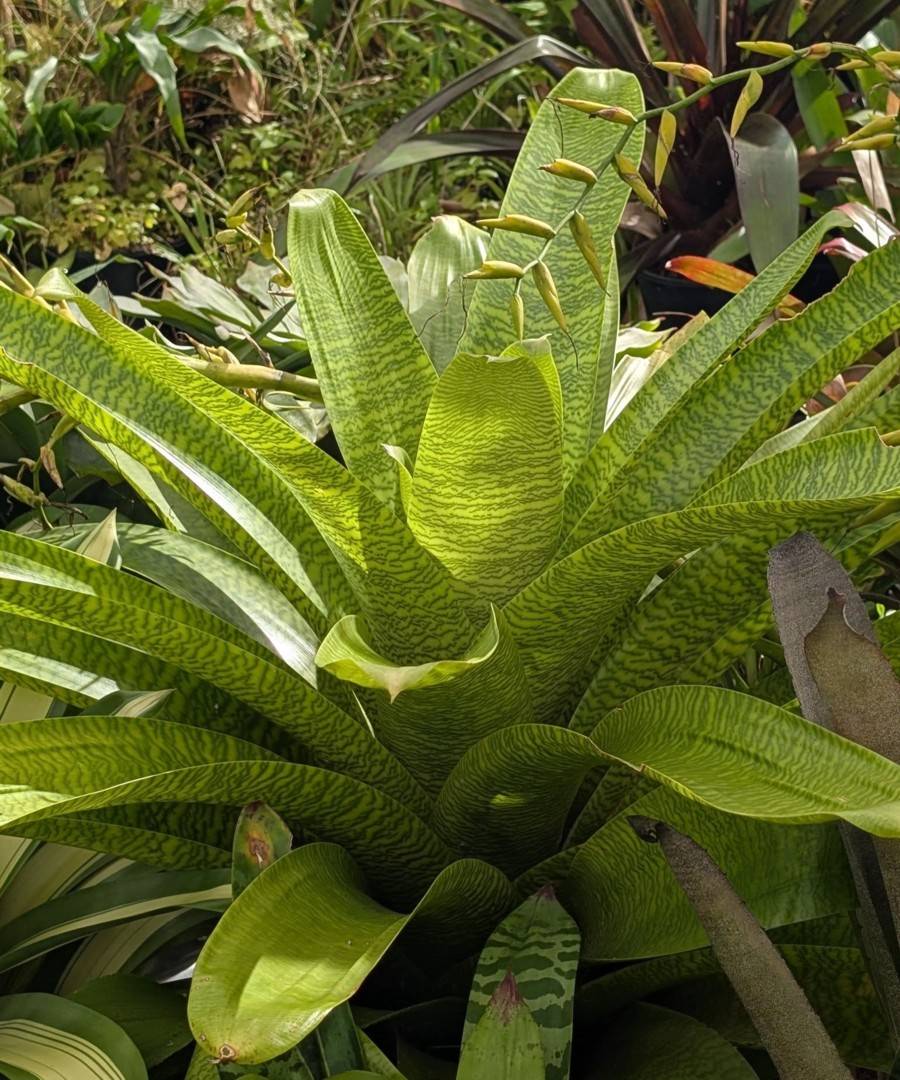
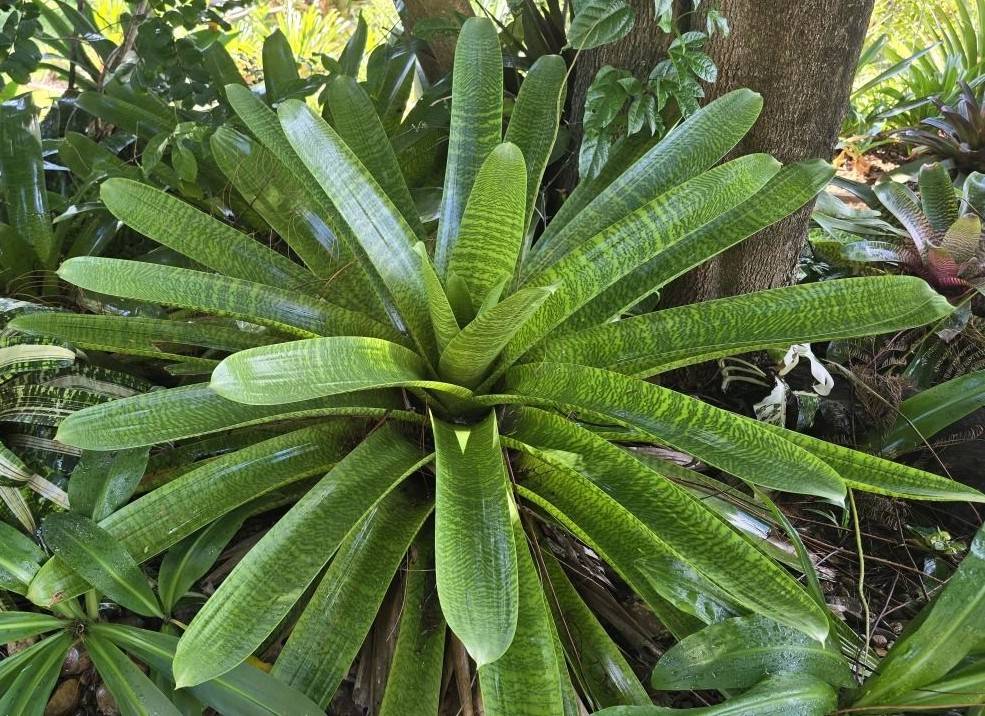
Material examined: Rio de Janeiro state: Paraty, Alto da Serra, January 1995, Rafael 0. de Faria s.n. (HB). Rio de Janeiro, Parque Nacional da Tijuca, 3 July 1995, E.M.C. Leme, Angela S. Garcia, Rageria Ribeira, Rafael 0. de Faria s.n. (photo, HB). Parque Nacional da Tijuca, 21 May 1974, R. Reitz 7603 (HBR, N.V; photo HB).
Notes
Vriesea pastuchoffiana is the other species recently found. The sparse data available concerning the collection of the type dates back to 1879 and in the last 116 years the only new information was provided by Raulino Reitz in 1975. He collected the species the year before (dried specimen deposited in HBR not examined, but the photo of its two sheets was handled) and stated it was very rare.
The species was presented to science by Carl Mez in 1894 based on a specimen collected by Auguste Glaziou on Morro Queimado in the heart of the city of Rio de Janeiro. It was believed that this plant no longer existed in this area because of the destructive effect of urban expansion, as has happened with other species such as V. warmingii (Leme & Till, 1993). However, through the work of Angelo S. Garcia and Rafael 0. de Faria, both members of the Sociedade Brasileira de Bromelias, two populations were found about 250 km from each other.
A more important population by reason of its historic value, although very much reduced in number, was found on a mountain near the type locality confirming previous data provided by Reitz. This population, although located in the Parque Nacional de Tijuca, is on the verge of collapse because of periodic burnings and the impact of tourist traffic. We found only four adult specimens in the entire area: two of them in post-floral stage, and 15 young individuals from one to five years old. Perhaps, if human traffic could be interrupted for a while and the few survivors were managed to promote their growth, reproduction and recolonization, this small population could be preserved.
The discovery of the second population of Vriesea pastuchoffiana, at the crest of the mountains in the Paraty region of the State of Rio de Janeiro at altitudes of approximately 600-700 meters, gave proof that the species is not limited to the mountains of the city of Rio de Janeiro.
On the other hand, we regret that this discovery is connected to the trail of destruction left by criminals who steal the plants. At this location, we observed V. pastuchoffiana forming large communities. The size of those groups has made it easy for thieves to remove very large quantities of the plants for sale. Local people have stated that after removing the plants, the "extractors" have set fire to the surrounding vegetation in order to make their product the more exclusive.
The morphological characteristics of the specimens studied coincide in every detail with the original description of the species, such as with the phototype that we have analyzed. The plants of the Paraty population do not present any variation worth noting when compared with the small population of Tijuca National Park. As for the plants of the park, we did not collect samples for obvious reasons. All notes and observations were made in the field. The photographs that we took have been deposited in the herbarium in order to document the finding. Thus, the data collected permitted easy identification of the specimens and served as the basis for the following description:
Vriesea pastuchoffiana is usually terrestrial, living at altitudes that vary from 600 to 900 meters. It forms dense groups at the crest of mountains. The species possesses irrefutable ornamental value owing to the beautiful, transverse patterns imprinted on the leaves. Its terrestrial habit permits cultivation. In contrast with V. hydrophora, which occurs in reasonably preserved areas, V. pastuchoffiana is faced with the concrete threat of becoming extinct, whether by destruction of its habitat in the Tijuca National Park, or by the thievery practiced in the Parity region. It will require the combined forces of scientific authorities, the police, and the courts to stop that practice.
Desc from S&D
Plant flowering 1 m or higher.
Leaves 1m long;
Sheaths inconspicuous, dark toward base;
Blades ligulate, broadly rounded with a narrowly triangular apiculus, 11 cm wide, marked with dark flexuous transverse lines, minutely lepidote.
Scape stout;
Scape-bracts unknown.
Inflorescence amply bipinnate, many-flowered, over 5 dm long;
Primary bracts suborbicular with short narrowly triangular recurved blades, about half as long as the sterile bases of the branches;
Branches spreading, densely 12-20-flowered, to 33 cm long, the long sterile base bearing a single bract at the middle;
Rhachis stout, nearly straight.
Floral bracts distichous, spreading, not secund with the flowers, very broadly ovate or suborbicular, minutely apiculate, 27 mm long, 29 mm wide, exceeded by the sepals, inflated, green, pale brown when dry;
Flowers spreading, secund, yellow;
pedicels 10 mm long, stout.
Sepals elliptic, obtuse, to 28 mm long, ecarinate;
Petals broadly ligulate, 35 mm long, bearing 2 ovate-triangular acuminate scales;
Stamens included.
Type. Glaziou 11684 (holotype B, isotype C, F photo 22338, isotypes K, NY, P), Morro Queimado, Guanabara, Brazil, 18 Jan 1879.
DISTRIBUTION. Known from the type locality only.
BRAZIL. GUANABARA: Quinta da Boa Vista, cultivated 4 Aug 1889, Glaziou s n (GH).