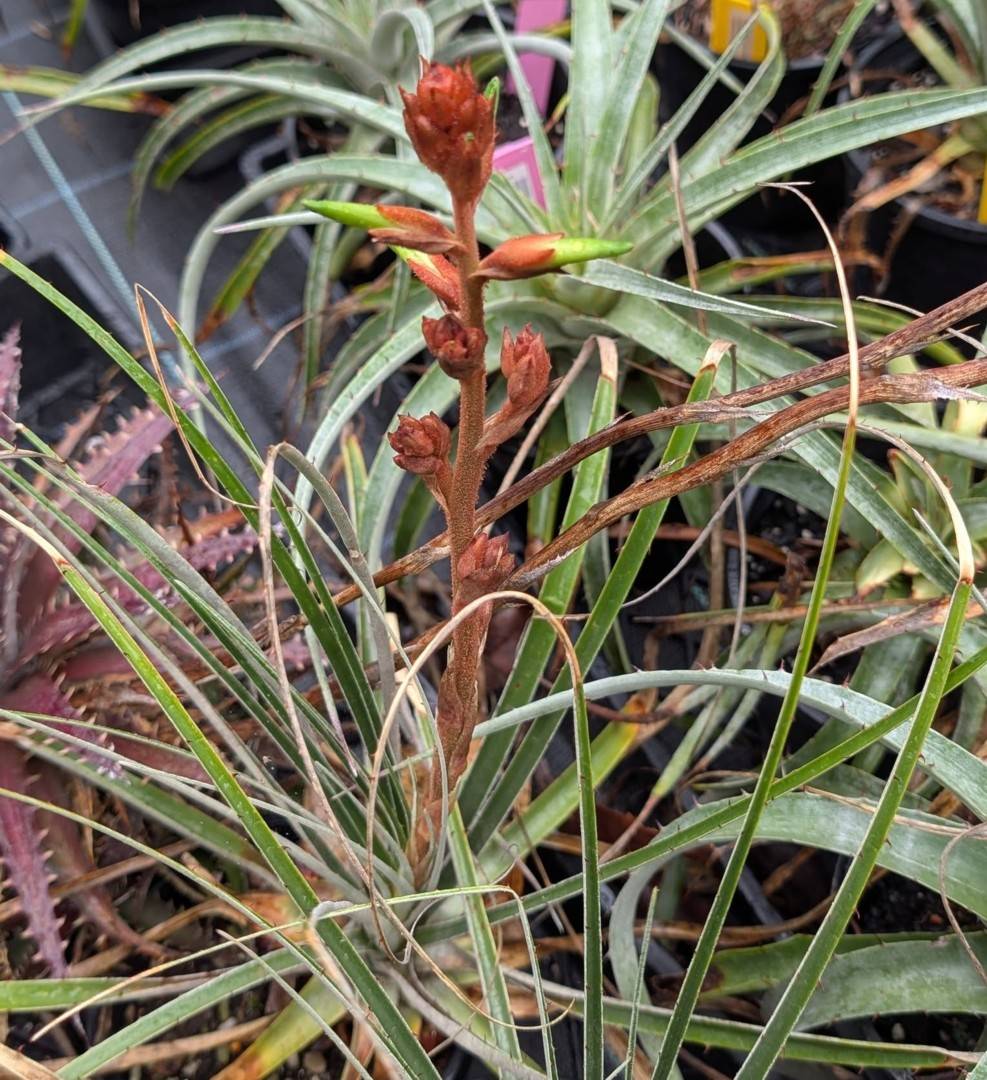
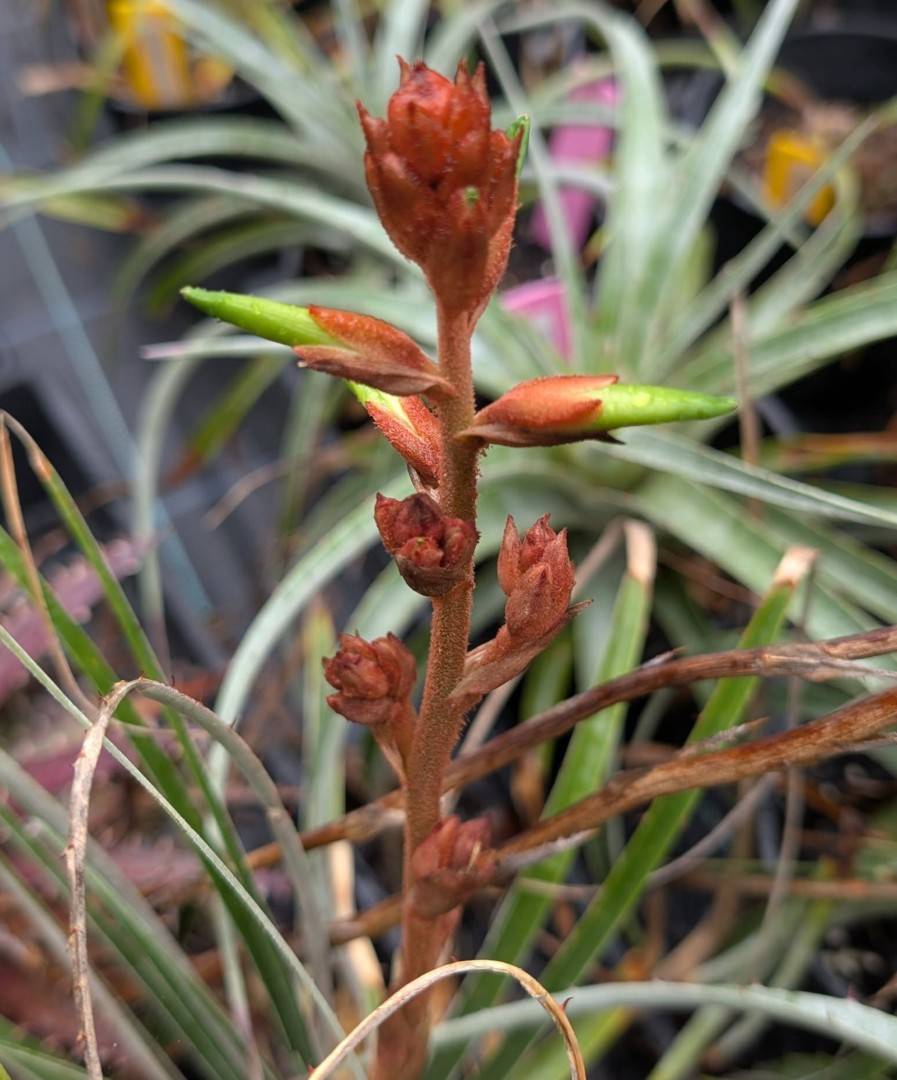
Type: BOLIVIA: COCHABAMBA: Prov. Ayopaya, from the Tunari highlands slopes in the direction of Morochata, at the entrance to the community of Cuevas, 3600 m, 17deg 13'S, 66deg 28'W, growing on rocks, 26 December 1999, R. Vasquez 3493,(Holotype: LPB.) Plate 3.
Plant terrestrial, growing on rocks, small, stemless, branching, forming groups of several individuals, flowering to 80 cm high.
Leaves numerous, bent back;
Sheaths fleshy, white, 2.5 x 2.5 cm;
Blades short, acuminate, stiff, about 180 x 15 mm, adaxial glabrous, green, abaxial totally covered with adjacent scales, whitish; Edges spiny serrated; spines antrorse and retrorse, 2-3 mm long.
Scape virtually erect, green, covered with russet starlike hairs after which the flower becomes glabrous.
Inflorescence simple, raceme, few flowered.
Floral bracts lanceolate, glabrous, shorter than the pedicels, 23 x 8mm, papery, dry at anthesis, edges entire.
Flowers 11 cm long, virtually erect to horizontal, usually secund, with the exception of the petals covered with ochre-brown to russet starlike hairs.
Pedicel 30-33 mm long.
Sepals rounded triangular, covered densely with starlike hairs, 28 x 10 mm, tip rounded.
Petals 70-75 mm long, 14 mm wide in the top part, rounded linear, green in bud, light green, twisting together after flowering.
Stamens enclosed, 63 mm long, greenish in the top-area;
anthers 10 mm long.
Gynoeceum 64 mm long, white, greenish in the top-area;
stigma lobes straight to wavy, green, 10 mm long.
Ovary 1/2 superior, white, 10 mm long.
Further Herbarium specimens examined: COCHABAMBA: Prov. Ayopaya, Morochata, 3200 m, Polylepis-Wald, 29. March 1991, I. Hensen 2100 (BOLV). This voucher was determined by L.B. Smith as Puya ferruginea R.&P.
Remarks: Also like Puya ferruginea (R. & P.) L. B. Smith is the inflorescence, primary bracts and sepals of Puya cochabambensis sp, nov. which have a loose coat of ochre brown to red brown starlike hairs. The new species clearly differs from this in its smaller size, the formation of cushions, stiff, essentially narrower and shorter leaves with smaller spines, a simple and unbranched inflorescence with half-erect to horizontal flowers, lanceolate floral bracts, oval-triangular sepals and oval linear petals. P. ferruginea is found in Cochabamba in moist mountain-rain and cloud forests, whereas P. cochabambensis sp.nov. comes from the dry Andean area over 3500m. Smith & Downs (1974) noted P. ferruginea as a very variable speces with very different large flowers. The above characteristics are now compared in Table 2.
Table 2: Differentiation of important characteristics of Puya cochabambensis sp. nov and Puya ferruginea
| Characteristics | Puya cochabambensis sp.nov | Puya ferruginea (R. & P., L.B.Smith - after R. Vasquez 3482(VAS) and Smith & Downs 1974 | Plant | branched forming clumps flowering to 80 cm high | usually individual, flowering to 2.5(-4) m high | Leaf blades | stiff, 18 x 1.5 cm | thin flexible, 100 x 5 cm | Inflorescence | simple | usually a panicle, branching | Flowers | half-erect, secund horizontally | hanging | Floral bracts | lanceolate | oval | Sepals | oval-triangular | oval-linear | Petals | oval-linear, light green | whitish green |
The inhabitants of the community Cuencas call this species "wiq'onta"; which in Quechua, (see Lara 1991) means different Puya species. The Latin species name refers to the Department Cochabamba, which has significantly diverse and endemic species of Puya (Ibisch 1998). It is virtually unbelievable that there is no Puya of this name until now. Altogether, 56 described Puya species are now known from Bolivia, and 19 from the Department of Cochabamba.
Range, Ecology and protection statuses: this species grows on rocks and in the area around Cuevas forms large colonies. It is presumable endemic to the Province of Ayopaya, Department Cochabamba. The place of discovery lies in a narrow inter Andean high-valley with tropical half dry cold mountain-climate. Nearby (at about3800-4000 m,) a large occurrence of Puya cardenasii L B Smith is located, and in the direction of Morochta was located another, now uncertain Puya species. After calculation of the national protection-value (after Ibisch 1998: 32+2+0+0+4=38) this species can be regarded as threatened (In the National Register).
Summary: Puya cochabambensis R. Vasquez & P. L. Ibisch, sp. nov., from the central high Andes (Dpto. Cochabamba, Prov. Ayopaya) has red brown stellate scales like Puya ferruginea R. & P. but differs clearly in the caespitose growth form, the small size of the plants, stiff (not lax and slender) and much smaller leaves with smaller spines, simple (not paniculate) inflorescence, secund, suberect to horizontal (not pendulous) flowers, lanceolate (not ovate) floral bracts, ovatetriangular (not ovate-linear) sepals and ovate-linear (not linear) petals.