Pitcairnia hitchcockiana
Click thumbnails for full size, scaled to a new window.
Pitcairnia hitchcockiana
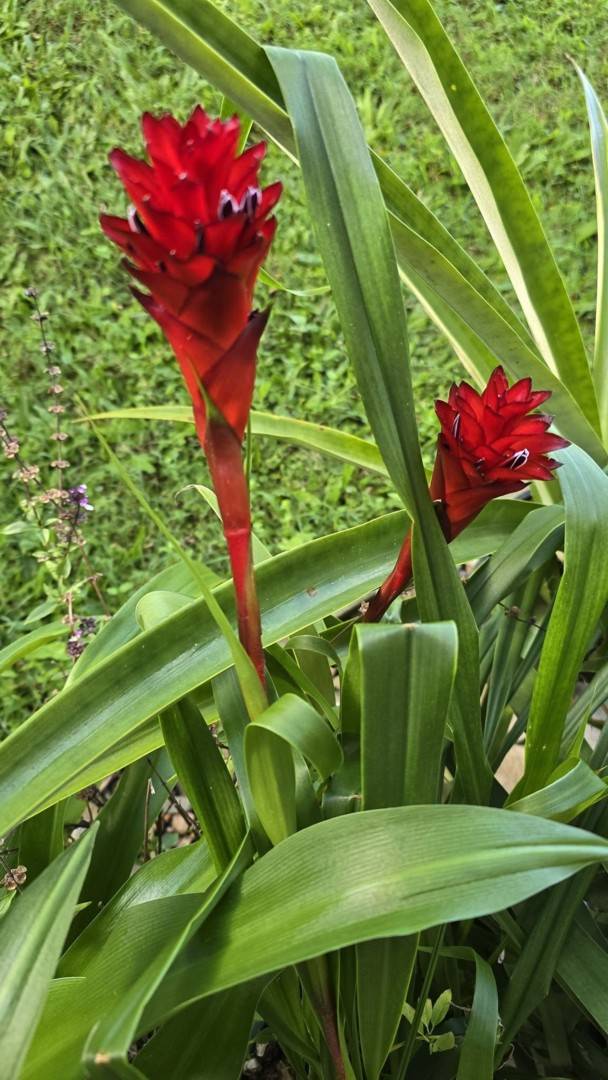
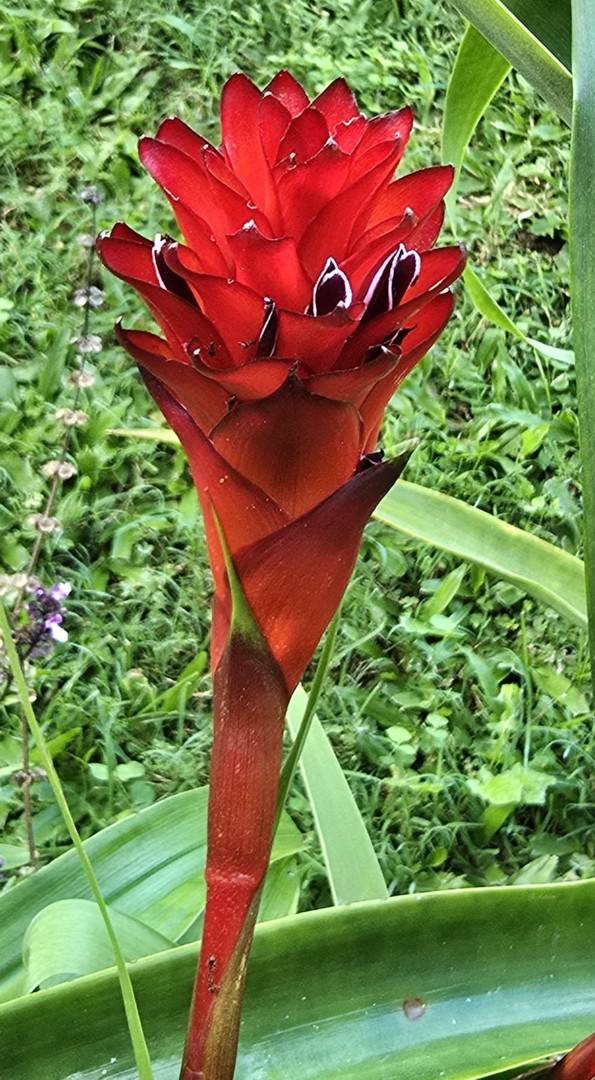
| Peter Tristram 06/26 from Bruce Dunstan seed |
Pitcairnia hitchcockiana by Derek Butcher
This story starts in 1981 where in the BSI Journal #2 1981 pages 49 and 96 there appeared pictures of Pitcairnia nigra by Dr. H Hemker. In BSI Journal #4 1981 page 178 Werner Rauh wrote that the name of the Pitcairnia on cover page 49 was not P. nigra although that on page 96 was correct. "The cover may be of Pitcairnia puyoensis but I am not quite sure. I have also collected this plant, but have not been able to identify it."
In 1984 Werner Rauh described Pitcairnia albomarginata (Bromelien Studien XV 1984) which was collected near Puyo in central Ecuador and is undoubtedly the plant he was going to call P. puyoensis. In his differential diagnosis he compares his plant with P. hitchcockiana. The differences were "Leaves not distichous, the posterior sepals certainly sharp keeled but not winged; Petals not red but on the contrary are dark blackish violet with white edges."
In De Rebus I in 1994 Pitcairnia albomarginata was made a synonym of P. hitchcockiana. Nothing has been written about the range of petal colour or leaf arrangement we can now expect to find in P. hitchcockiana.
In Bromeliaceas of Venezuela (1987) page 368 P. hitchcockiana is featured and whereas the written description refers to this plant the photograph doesn't.
In Phytologia 41: 331, 339 (1979) L B Smith and R W Read emended the description of P. hitchcockiana by pointing out that although the floral bracts were erect in the type, other collections showed them to be arched-divergent.
In early 1999 Andrew Maloy of New Zealand was trying to get a Pitcairnia identified and eventually Harry Luther of the Marie Selby Gardens identified it for him. See photograph.
We have also been lucky to have had Hattie Lou and Sam Smith involved in this naming saga.
If there is a moral to this story it would be that even photographs in reputable publications are sometimes in error!
Pitcairnia hitchcockiana L.B. Sm., Phytologia 5: 44, pl. 6, figs. 1-3. 1954.
See Manazanares in Brom of Ecuador, Pitcairnioideae 429-30. 2005
Pitcairnia albomarginata Rauh, Trop. Subtrop. Pflanzenwelt 50: 29-32, Abb. 15-16. 1984. Type. Collected in Puyo, Ecuador, flowering in cultivation in Heidelberg, Rauh 52920 (HEID). June 1980.
PLANT flowering 65 cm long, stem 20 cm tall, caulescent.
FOLIAGE pendent, very numerous, petiolate, persisting, monomorphic.
LEAF-SHEATHS 6 cm long, 3 cm wide, ovate, coriaceous, margins entire, venation evident, lepidote, brown.
PETIOLE 10 cm long, canaliculate, margins entire.
LEAF-BLADES 43 cm long, 2.8 cm wide, margins entire, linear-lanceolate, canaliculate, apex filiform to attenuate.
INFLORESCENCE 8 cm long, 4 cm wide, simple, 15-20 flowers, dense, strobiliform and ellipsoid, apical sterile bracts.
PEDUNCLE shorter than the leaves, 40 cm long, 4 mm in diameter, slightly curved, red, lepidote.
PEDUNCLE-BRACTS lower foliaceous, imbricate and exceeding the internodes, 7-20 cm long, 7.6 cm wide, lanceolate, apex attenuate, green, erect.
FLORAL-BRACTS 30 mm long, 17 mm wide, elliptic, apex acute, ecarinate, nerved, lepidote at the base, imbricate, scarlet-red.
FLOWERS erect, corolla actinomorphic, dark purple with or without white margins; pedicels obconic, 2 mm long; stamens-pistil included and exposed.
SEPALS 20 mm long, 6 mm wide, lanceolate, distinctly nerved, posterior sepals carinate, apex acute, glabrous.
PETALS 3 cm long, with one 5 mm long ligule at the base, erect.
OVARY three quarters superior.
SEEDS caudate.
Type. Hitchcock 21816 (holotype: NY; isotypes: GH, US), from Banos to Cashuarco, river Pastaza, province of Tungurahua, Ecuador, Sept . 25, 1923.
Etymology. Named in honor of its discoverer, the American botanist Albert Spear Hitchcock (1865-1935).
Observations. P. hitchockiana is commonly found in the provinces of the Amazonian and Tungurahua, forming dense colonies in road cuts. At fructification, the seed pods open, releasing an abundance of caudate seeds. They germinate easily, increasing the populations near roads. In the province of Napo the populations have an inflorescence with purple flowers and white margins, while those in the other provinces are totally purple. The pendent leaves have entire margins.
Pitcairnia hitchcockiana L. B. Smith, Phytologia 5: 44, pl. 6, figs. 1-3. 1954; L B Smith & Read, Phytologia 41: 331, 339. 1979
Pitcairnia albo-marginata Rauh, Trop. Subtrop. Pflanz. 50:29-32. 1984
Desc from S&D, in brackets from P. albo-marginata. Floral bract note from Smith & Read 1979
Plants densely aggregated, nearly stemless; flowering 5-6 dm high.
Leaves distichous, (not distichous) persistent, 8 dm long, entire, very sparsely white-flocculose, soon glabrous;
sheaths narrowly ovate, 3-4 cm long, brown;
petioles about 1 cm wide, strongly channeled;
blades linear-lanceolate, filiform-attenuate, 25 mm wide.
Scape 5 mm in diameter;
scape-bracts erect, foliaceous, densely imbricate.
Inflorescence simple, strobilate, slenderly ellipsoid, 10 cm long, 3 cm in diameter.
Floral bracts in about 4 or 5 ranks, closely imbricate, broadly elliptic, acute, 5 cm long, scarlet, subcoriaceous; nerved when dry, finely flocculose toward base; (Erect in type but others arched-divergent)
pedicels obconic, 2 mm long.
Sepals lanceolate, acute, 19 mm long, brown-flocculose, the anterior ecarinate, the posterior alate-carinate (sharp keeled);
petals 4 cm long, red (dark violet) with a narrow white margin, bearing a triangular scale at base;
ovary almost wholly superior; ovules caudate.
TYPE. Hitchcock 21816 (holotype, NY; isotypes, GH, US), Banos to Cashurco, Rio Pastaza, Tungurahua, Ecuador, 25 Sep 1923.
DISTRIBUTION. Saxicolous, moist cliffs, 1100-1500 m alt, northern Ecuador.
ECUADOR. TUNGURAHUA: Rio Topo to La Victoria, Rio Pastaza, 1 Dec 1939, Asplund 10029 (S, US); Banas, Rio Pastaza, 15 Feb 1953, Prescott 494 (NY); Machai, 30 Mar 1956, Asplund 20037 (S, US). NAPO: Mera, Mangayacu to Puente Quile, 31 Mar 1956, Asplund 20082 (S, US).
Pitcairnia hitchcockiana L. B. Smith emend. L B Smith & Read, Phytologia 41: 331, 339. 1979.
A descriptione originali bracteis florigeris per anthesin arcuato-dlvergentibus, a P. wendlandii Baker bracteis florigeris sine lamina, a P. clavata L. B. Smith foliorum laminis integerrimis multo angustioribus differt.
ECUADOR: TUNGURAHUA: Valley of the Pastaza River, between Banos and Cashurco, 8 hours east of Cashurco, on tree, 1300-1800 m, 25 September 1921, Hitchcock 21816 (holotype, NY; isotypes GH, US); valley of Rio Pastaza, between Rio Topo and la Victoria, cliff, 1200 m, 1 December 1939, Asplund 10029 (S, US); Banas, Rio Pastaza, 15 February 1953, Prescott 494 (NY); Machai, cliff, 1500 m, 30 March 1956, Asplund 20037 (S, US). NAPO: Mera Mangayacu to Puente Quile, 31 March 1956, Asplund 20082 (S, US).
In Flora Neotropica Monograph No. 14 this species was described and keyed as having erect floral bracts although most of the material beyond the type showed them arched-divergent. Consequently it is necessary to change its position to the vicinity of P. clavata.
The following specimen cannot be separated satisfactorily from P. hitchcockiana although it is a rather large disjunct: BRAZIL: MATO GROSSO:. Campo Grande, 1978, A. Seidel 778 (US).
Pitcairnia hitchcockiana L. B. Smith Notes from Phytologia 52:51. 1982
VENEZUELA TACHIRA: Around Represa Dorada, on sandstone bluff near river, 600-1000 m, 10-13 March 1981, Liesner & Gonzalez 10409 (MO, VEN, US); ca. 35 km south southeast of San Cristobal, La Buenana, 70deg 28' N, 72deg 09' W, 600-1200 m, 20-21 March 1981, Liesner & Gonzalez 10867 (MO, VEN, US); 10 km (airline) east southeast of La Fundacion, around Represa Dorada, 70deg 47' N, 71deg 46-47' W, 450-650 m, 29 April 1981, Liesner & Guariglia 11563 (MO, VEN, US). New to Venezuela.
Pitcairnia albo-marginata Rauh, Trop. Subtrop. Pflanz. 50:29-32. 1984 Treated in DeRebus I, 1994 p22 as a synonym of P. hitchcockiana.
Planta turmas formans; planta singularis caule brevi, florens usque ad 60 cm alta. Folia pauca (circiter 6) pro rosula, homomorpha, fasciculata, inflorescentiam superantia. Vaginae distincte limitatae, triangulatae, basi 1 cm latae, 2 cm longae, subtus castaneae, nervatae floccoso-lepidotae, supra glabrae lucentes. Laminae basi involutae, de ea causa in partem basalem 20 cm longam, 0.3 cm crassam modo petioli disperse floccosam inermem se angustantes. Lamina plane angustolinealis, usque ad 50 cm longa, 2.5-3 cm lata, longe attenuata utrimque fere glabra, subtus nervo mediano prominulo, margine inermis, arcuata. Scapus inflorescentiae erectus, plus minusve 20 cm longus, 0.5 cm diametiens, teres, rufescens, dense lanato-floccosus. Phylla scapae pauca (usque ad 5), basalia 2-3 subfoliata, inflorescentiam longe superantia, superiora bracteis floralibus similia. Inflorescentia simplici-cylindrica, usque ad 6 cm longa, 2.5 cm lata. Bracteae florales dense spiraliter insertae, flores omnino obtegentes, basales phyllis scapi superioribus similes, virides vel rufescentes, superiores erectae late patelliformes apicibus brevibus paulum recurvatae, axem basi lata amplectentes, late ovali-acuminatae, basales usque ad 7 cm longae, in dimidio superiore atro-cinnabarinae, basim versus laetiores, virides, utrimque disperse brunneolepidotae, flores omnino obtegentes, subsessiles usque ad 4.5 cm longae. Sepala usque ad basim libera, 15-18 mm longa, oblongo-lanceolata, obtusa disperse brunneo-lanata, imprimis ad apicem; sepala posteriora distincte carinata, alba, rubro-apiculata. Petala usque ad 4 cm longa, apicibus contortis, paulum divaricatis, obscuro-atroviolacea limbo albo, basim versus alba, supra ligula bidentata, paulum discedentia. Antherae stylumque inclusae. Filamenta alba, valde plicata, thecae luteae inclusae. Stylus albus. Ovarium fere omnino superum, ovula longe caudata.
Holotypus: RAUH Nr. coll. 52 920 (Juni 1980), in herb. inst. bot. system. univ. heidelb. (HEID).
Habitat et distributio: Aequatoria centralis, prope Puyo terricola at copiose in rupibus.
Plant forming groups; a single plant with short stem, flowering tol 60 cm high.
Leaves few (~6) in a rosette, homomorphous, fasciculate exceeding the inflorescence.
Sheath distinct, triangular, at the base 1 cm wide, 2 cm long, underneath chestnut brown, nerved, floccose scaled, upper side glabrous, shiny.
Leaves rolled up at the base of the blade into a to 20 cm long, 0.3 cm thick, stem like, with scattered floccose scales, narrow spineless basal section.
Blade narrow-linear, to 50 cm long, 2.5-3 cm wide, long attenuate, both sides almost glabrous, flat, underneath with a prominent mid nerve, edges entire, bent over (fig. 15, left).
Scape erect, ~20 cm long, 0.5 cm thick, round, reddish, densely lanate floccose.
Scape bracts few (to 5), the basal 2-3 subfoliate, far exceeding the inflorescence, upper ones similar to the floral bracts.
Inflorescence simple-cylindric, to 6 cm long, 2.5 cm wide.
Floral bracts densely spiralled, fully covering the flowers, (fig. 15, right); the basal ones similar to the upper scape bracts, green to reddish, the upper ones erect, broad shell like with short bent back tip (fig. 15, right; fig. 16,) with the broad base enclosing the axis, broad-oval-acuminate, the basal ones to 7 cm long, the upper half dark cinnabar red, the base lighter and green, both sides scattered brown lepidote, fully enclosing the flowers;
Flowers subsessile, to 4.5 cm long.
Sepals free, 15-18 mm long, longish lanceolate, blunt, scattered brown-wool, particularly at the tip, posterior pair sharply keeled and flat, white, red tipped (fig. 16, right.)
Petals to 4 cm long, erect, the tips overlapping, dark-black-violet with white edge, the base white (fig. 16, right), upperside with a 2-toothed ligula.
Stamens and Style enclosed.
Filament white, strongly pleated, pollen-sack yellow, enclosed. Style white.
Ovary almost fully superior, ovules long tailed.
Holotype: Rauh 52 920 (June 1980), in (HEID).
Habitat and range: terrestrial in a dense stand of rocks near Puyo (central-Ecuador).
The plant is similar to P. hitchcockiana L. B. Smith, but differs from this in the following characteristics:
Leaves not distichous, posterior sepals sharp keeled but not alate;
Petals not red but dark-black-violet and white edged.
Updated 28/06/26