

The Pitcairnia genus is named after a London doctor, Pitcairn. The genus can be found from southern Mexico and the West Indies down to northern Argentina and Peru. Most species are found in Brazil, Colombia and Peru. The only bromeliad species whose native habitat is outside of the Americas is a Pitcarinia, namely, P. feliciana, which grows on cliff faces in tropical West Africa.
Many botanists argue the genus Pepinia should be included in the Pitcairnia genus. However, in this article the distinction has been maintained. There are over 250 species in these two genera.
Most pitcairnia and pepinia are grass-like plants that grow in the ground (terrestrials) or on rocks (lithophytes). A few are epiphytes. Most grow in moist, shady locations. Typically, they form a clump that develops through underground rhizomes.
The leaves of many pitcairnia and pepinia are spineless, while those plants with spines generally have small ones.
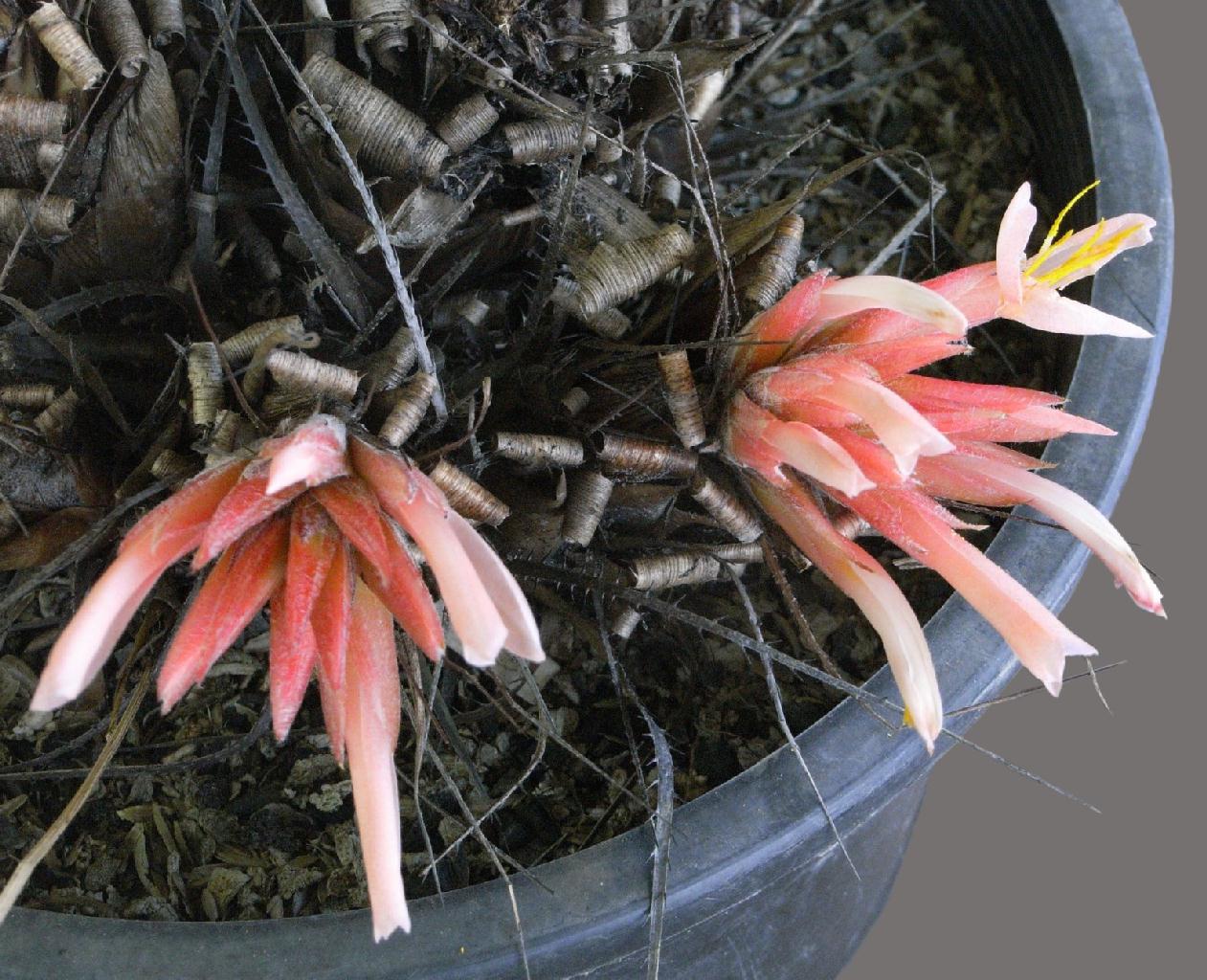
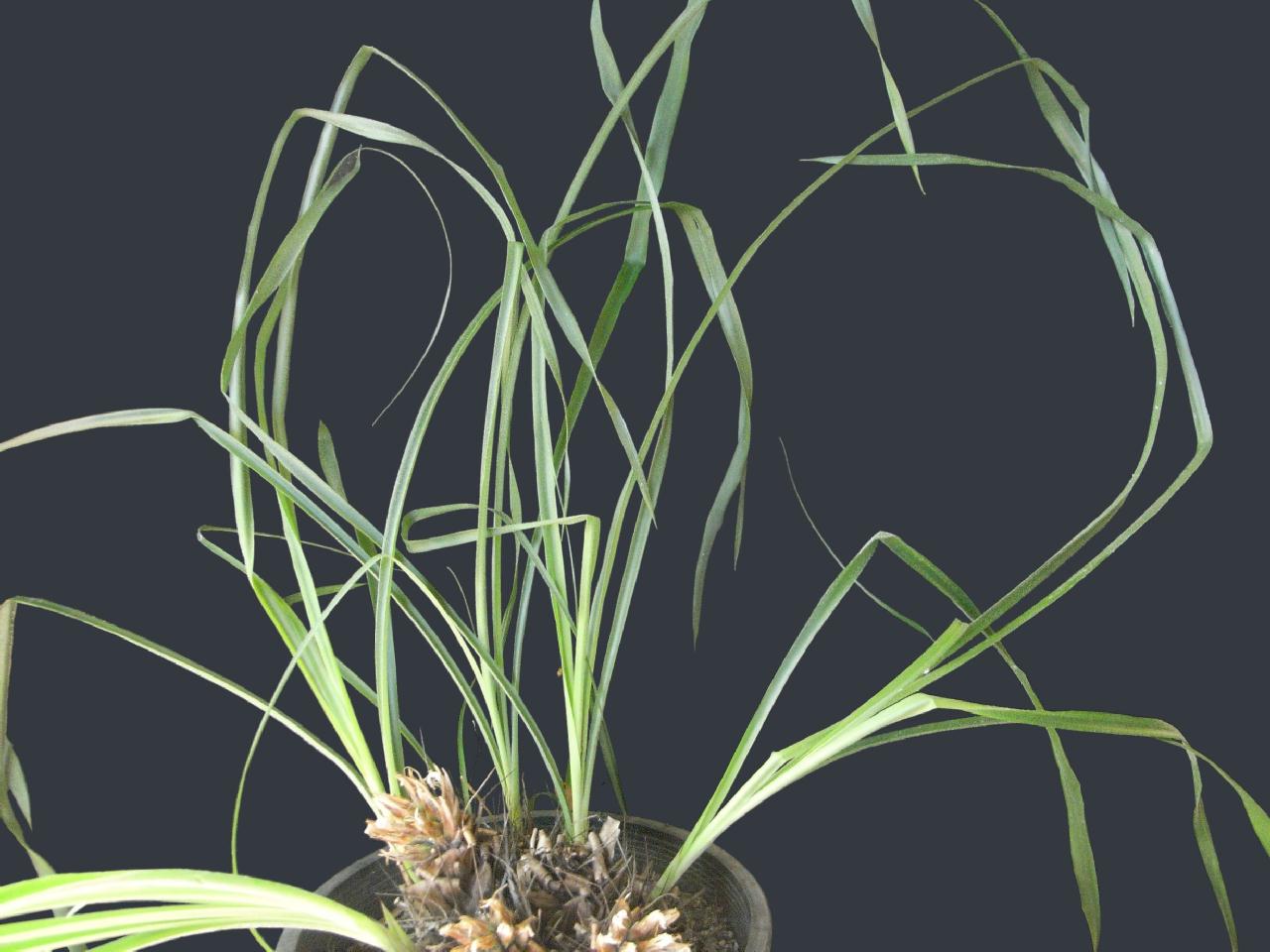
These plants' leaves are quite variable in length and shape. Some have several types of leaves on the one plant. Perhaps the most graphic example of this variation can be found in "deciduous" species such as Pitcairnia heterophylla. In that species, the "normal" leaves drop off at the start of the dry season to help the plant conserve moisture. The short brown "spikes" that remain are a primitive type of leaf that contains no chloroypyll.
Pitcairnia and Pepinia can be propagated easily either from seed or, for many species, by detaching a piece of the underground rhizome (taking care to obtain a piece with roots attached). The underground rhizome can be severed by either using a knife or, in some cases, a spade! Other Pitcairnia and Pepinia form bulbous-like growths that can be broken apart to provide new plants.
These plants will thrive if grown in a mixture similar to that used for most indoor plants. A mixture, which has given good results for myself, is comprised of 1 part Cocopeat or peatmoss to 1 part of coarse sand. A continuous release fertiliser, such as Osmocote, should be added to the potting mixture in the concentrations recommended by the manufacturer for indoor plants.
Re-pot the plants once a year. They typically like bigger pots for their size than other bromeliads. For example, a single offshoot of many species can often be grown into a small clump that requires a 250 mm bucket within 30 months.
Plants should be watered until water starts to flow through the pot's base, at least three times a week in summer. Twice a week in winter should be adequate, except during periods of low humidity.
These plants' leaves generally do not suffer from insect attacks, although grasshoppers can attack young leaves on rare occasions. However, aphids can cause significant damage to flowers.
Pitcairnia and Pepinia will grow well under 50% shadecloth in winter and 75% for the rest of the year. They also thrive in shaded (but well drained for virtually all species) areas in the garden, but are unlikely to do well in situations that receive the full afternoon sun (especially in summer).
When grown in the ground, pitcairnia's relatively tall (usually 50cm or more) green, grass-like foliage can form an effective "backdrop" to a planting in front of them, comprised of their more colourful bromeliad brethren, for example, Neoregelia.
The ancestors of many of the plants currently grown in Australia were obtained by growing plants from seed obtained from overseas. While many interesting plants were obtained, unfortunately it has become obvious that quite a few are incorrectly identified.
While there are few named Pitcairnia and Pepinia hybrids, it is possible many of the "species" grown in Australia could be hybrids. Alternatively, some species are much more variable in appearance than is commonly believed.
Pitcairnia and Pepinia are not readily available. However, you should be able to build up a collection of 10 or more species, over a period of several years, by searching for them at the Society's field days, monthly meetings and shows, and asking bromeliad nurseries. If you are willing to settle for a rhizome with a few leaves and roots attached, rather than a well-established plant in a pot, then you are in the best position to quickly build up your collection.
Eighteen species are described below. However, it is likely there are at least 30 species and hybrids cultivated in Australia.
Pepinia sanguinea. The plant's arching leaves are up to 60cm long and 6cm across at their widest point. The leaves are a "velvet green", flushed with maroon, on their upper surfaces, and maroon underneath. This plant is well worth growing. Several hybrids have been made with it as one of their parents.
Pitcairnia andreana. This is one of the smallest plants in the genus. The light green leaves are 30 to 40cm long and up to 4cm wide. The inflorescence rises above the leaves on a stalk that is about 15cm long. A cluster of around 10 flowers, each of which is about 10cm long, constitute the inflorescence. The flower's petals are orange at their base, and yellow for their remaining length.
Pitcairnia burle-marxii. This plant has a "caulescent" growth habit, that is, it has a distinct stem. The semi-succulent leaves are 3cm wide and 15cm long, olive-green on top and maroon in colour underneath. It has a "simple", that is unbranched, spike of about 15 flowers.
Pitcairnia atrorubens. The arching, green leaves are up to 100cm long and 5cm wide at their widest point. The dark red, cylindrical spike, which is 40 to 60cm long, arises from a 30 to 50cm long stalk. The 3cm long flowers have yellow or red petals.
Pitcairnia carinata. The dark green leaves are about 60cm long and up to 3cm wide. The raceme (an elongated cluster of stalked flowers) is bright red, and 20 to 30cm long. The flowers have red petals.
Pitcairnia flammea v. roezlii. The arching leaves are 60 to 80cm long, and 3cm wide at their widest point. Each leaf's upper surface is dark green, while the underside is covered with a dense, silvery-grey "scurf". The cylindrical infloresence is about 40cm long, and 5cm wide. The top of the infloresence is about 60cm above the tips of the plant's leaves.
Pitcairnia funkiae. The arching green leaves are up to 100cm long and 8cm across at their widest point. A 20cm long, cylindrical, brown inflorescence does not reach the top of the plants' leaves.
Pitcairnia grafii. The light green leaves are 30cm long, 3cm wide, and form a semi-erect rosette about 50cm across. The infloresence rises well above the plant's leaves, and consists of a red-orange pyramidal spike about 30cm tall. Its flowers have yellow petals.
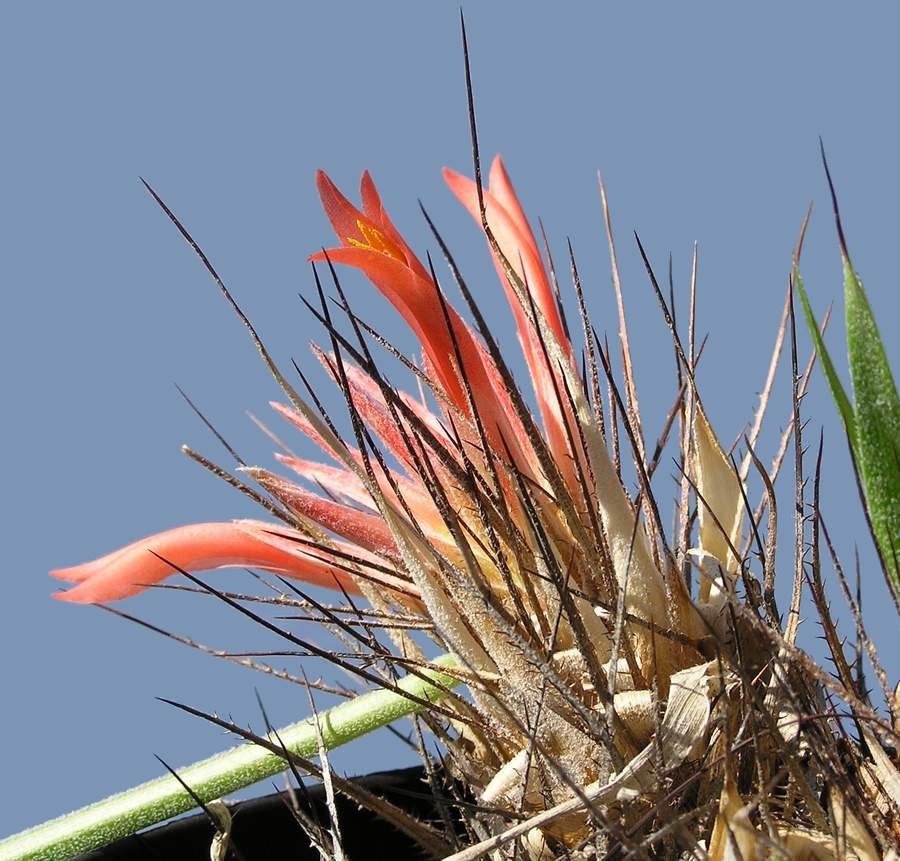
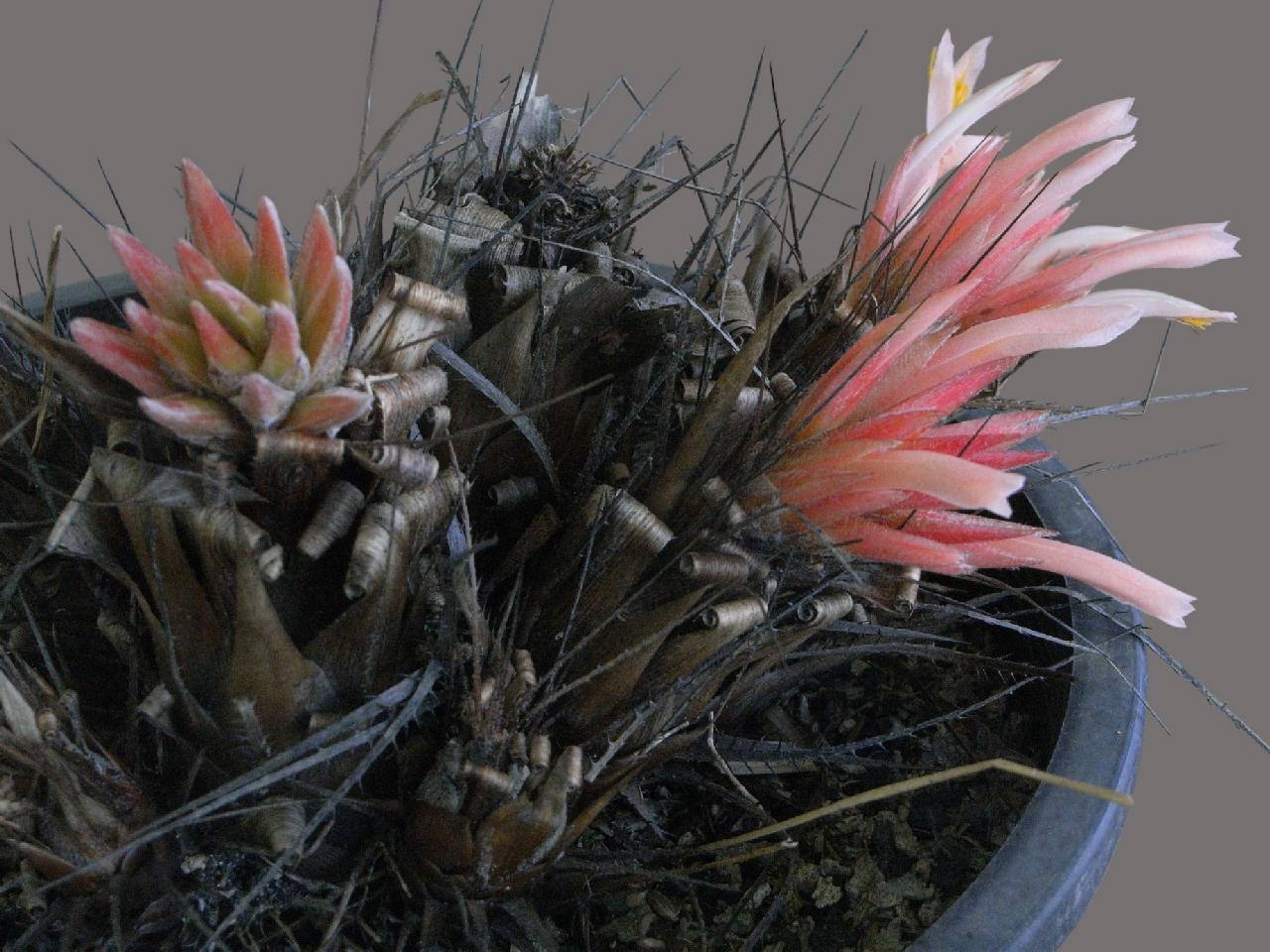
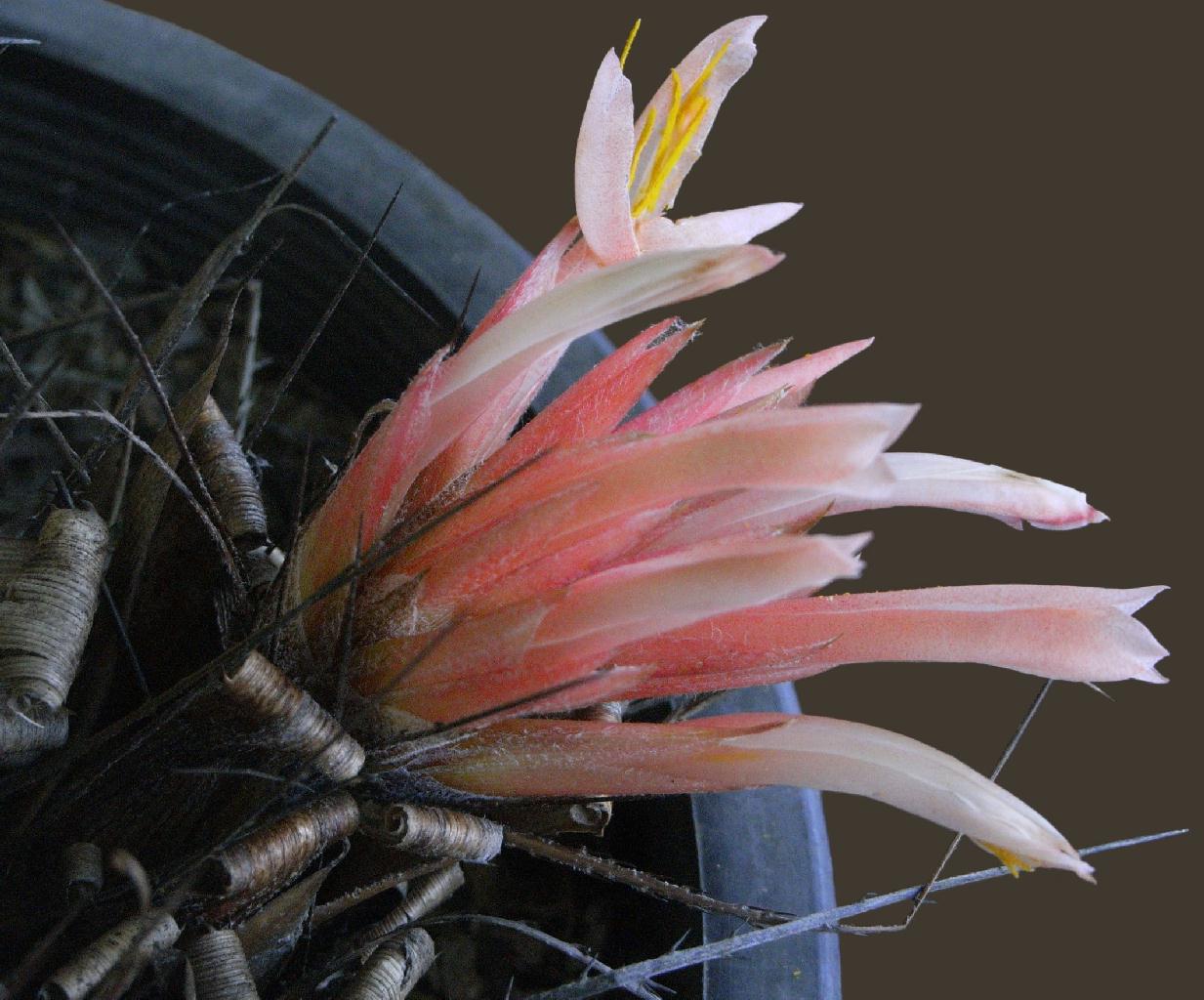
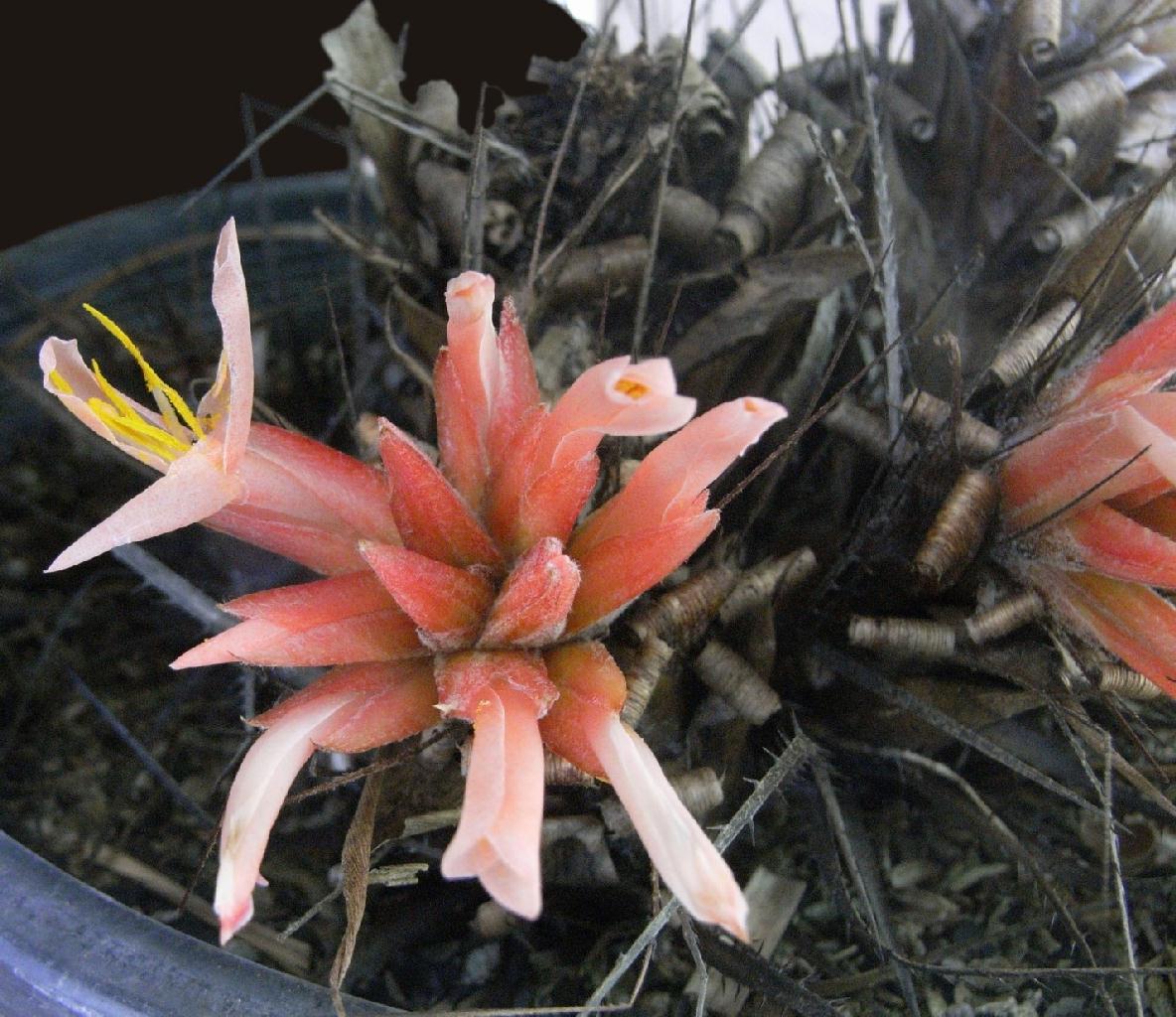
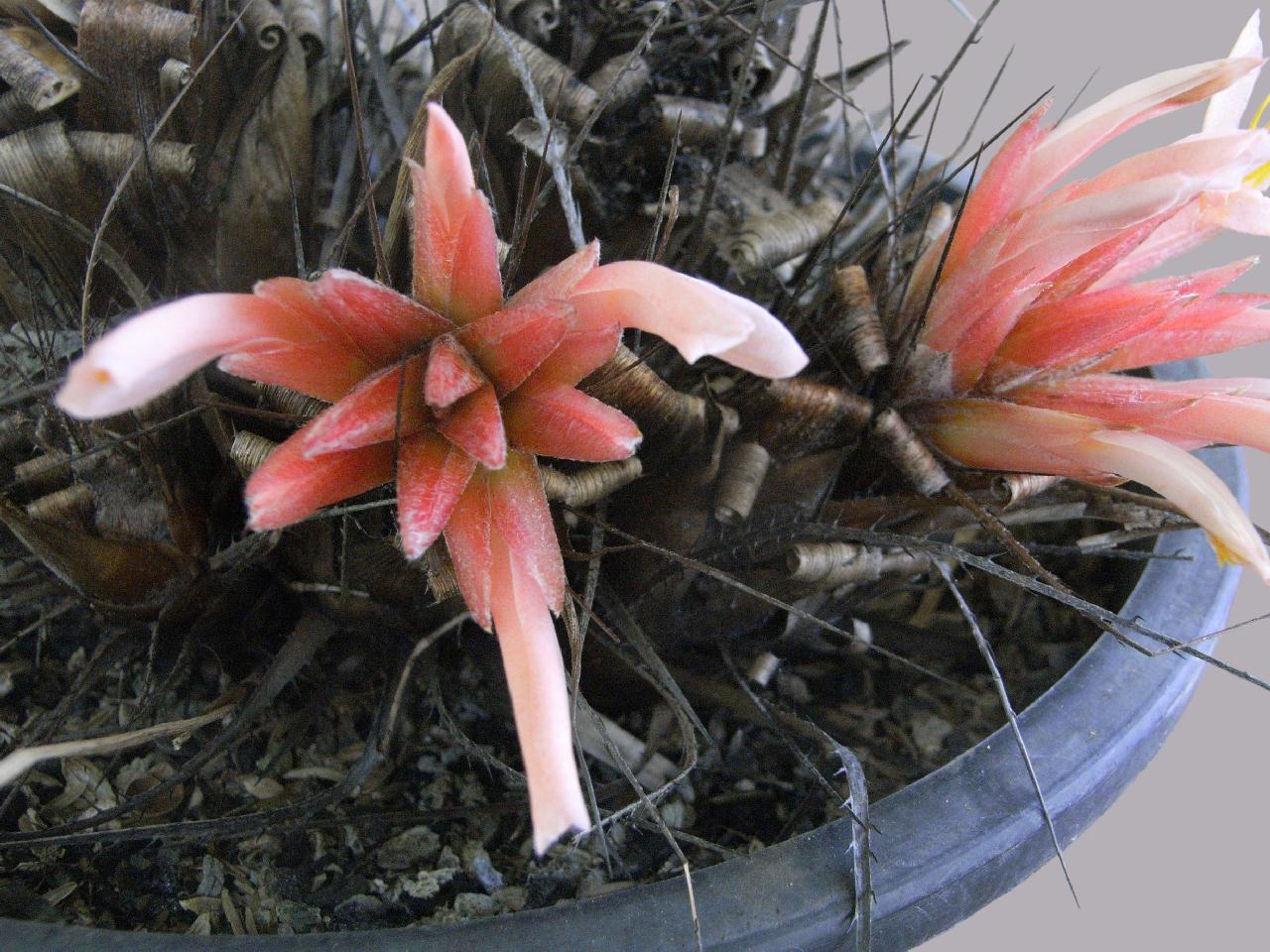
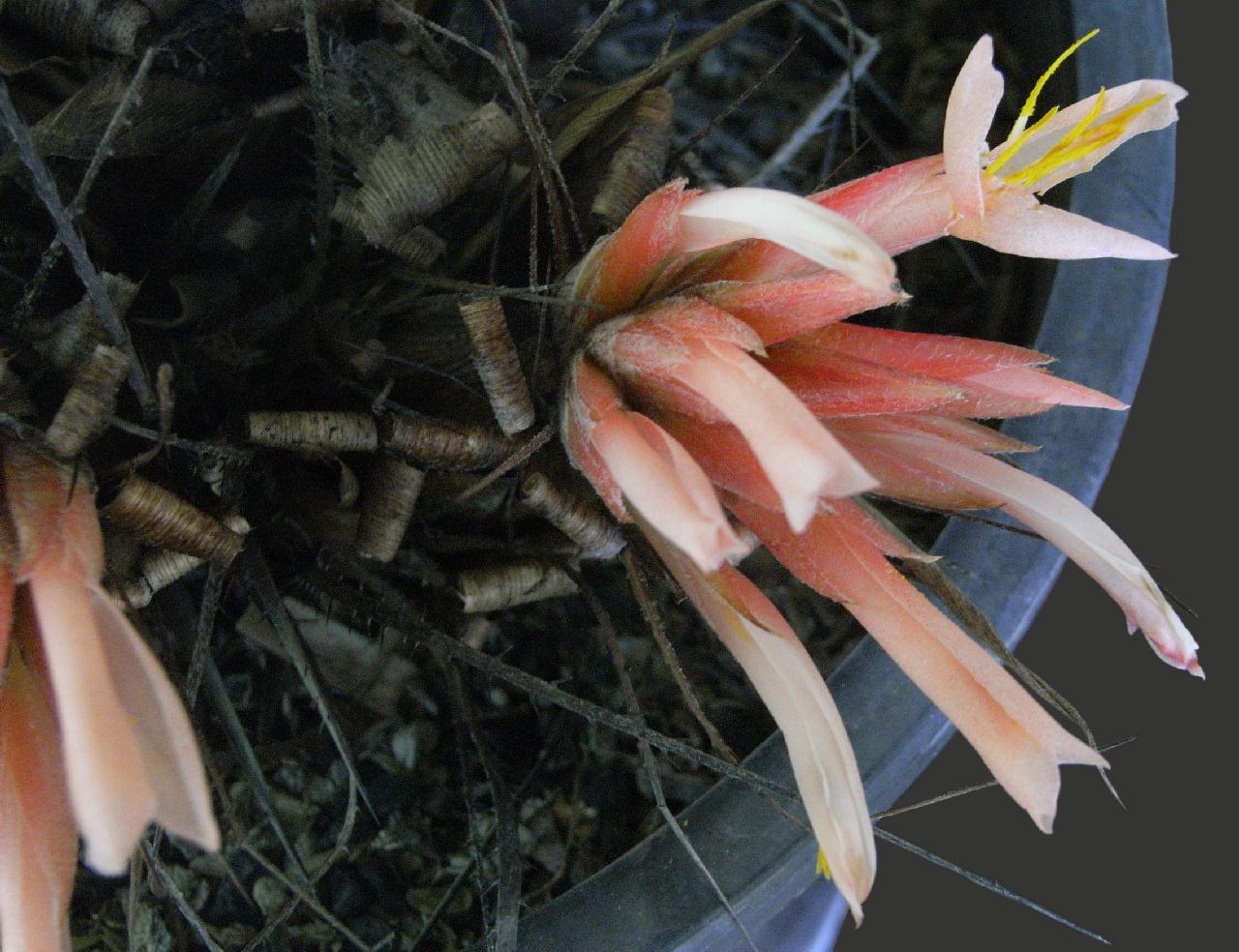
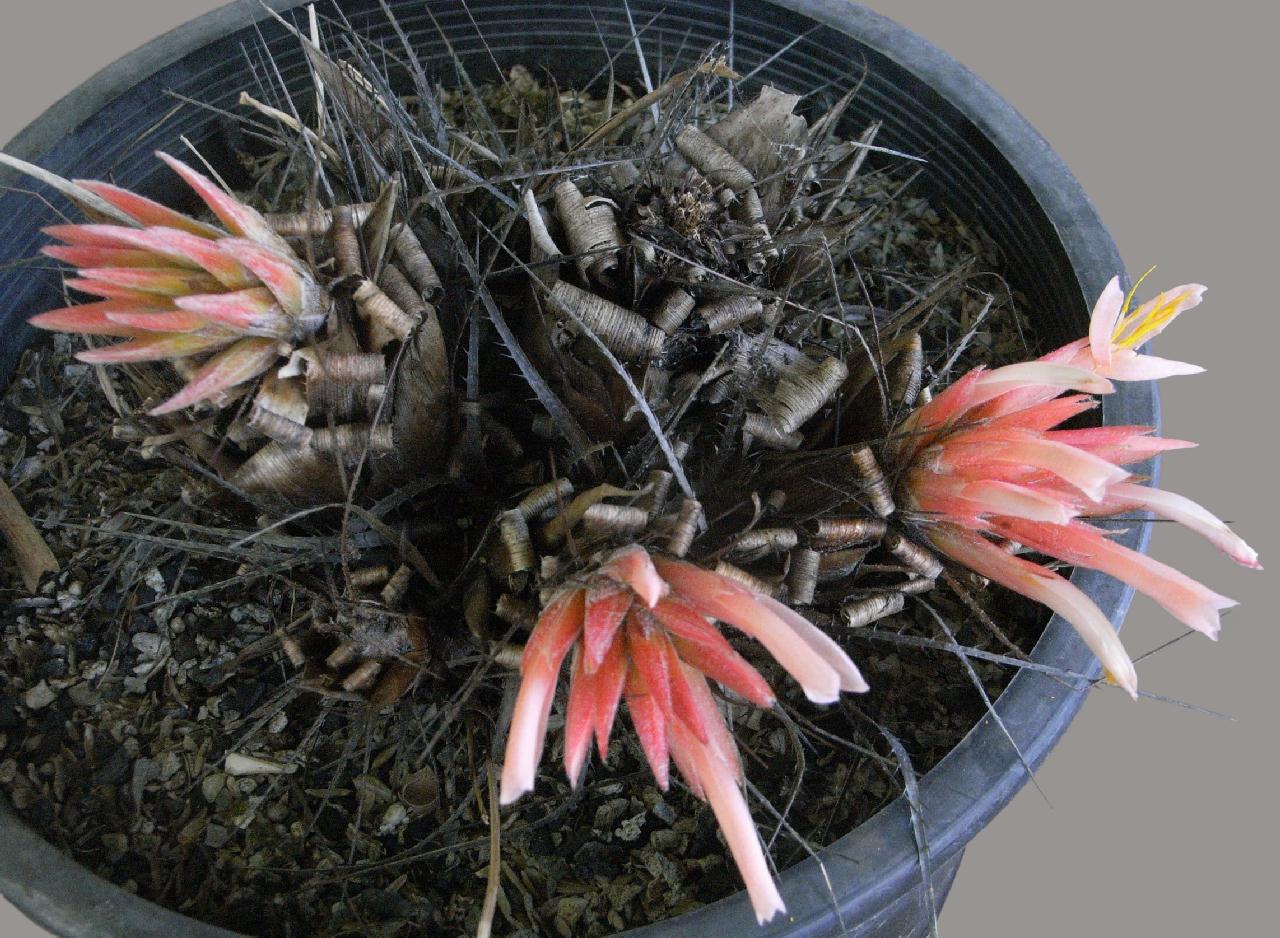
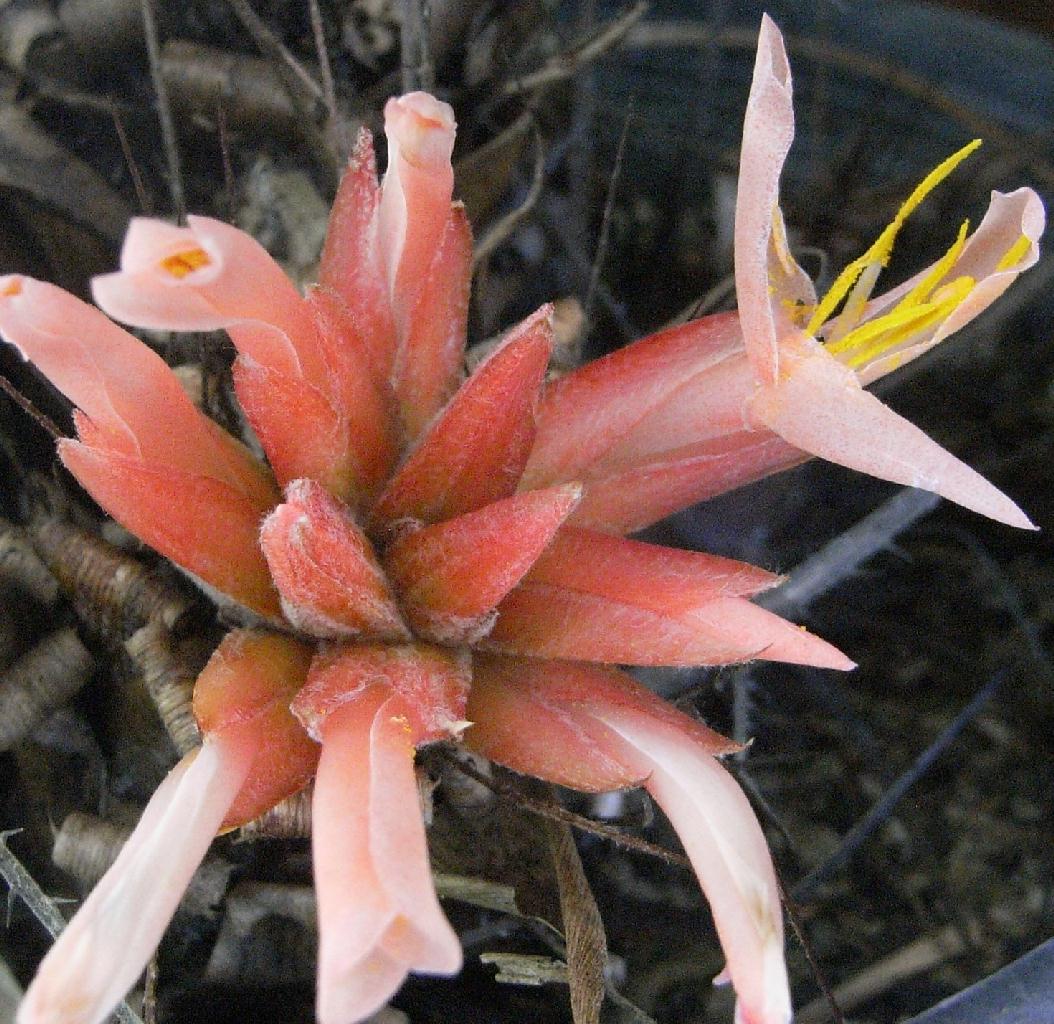
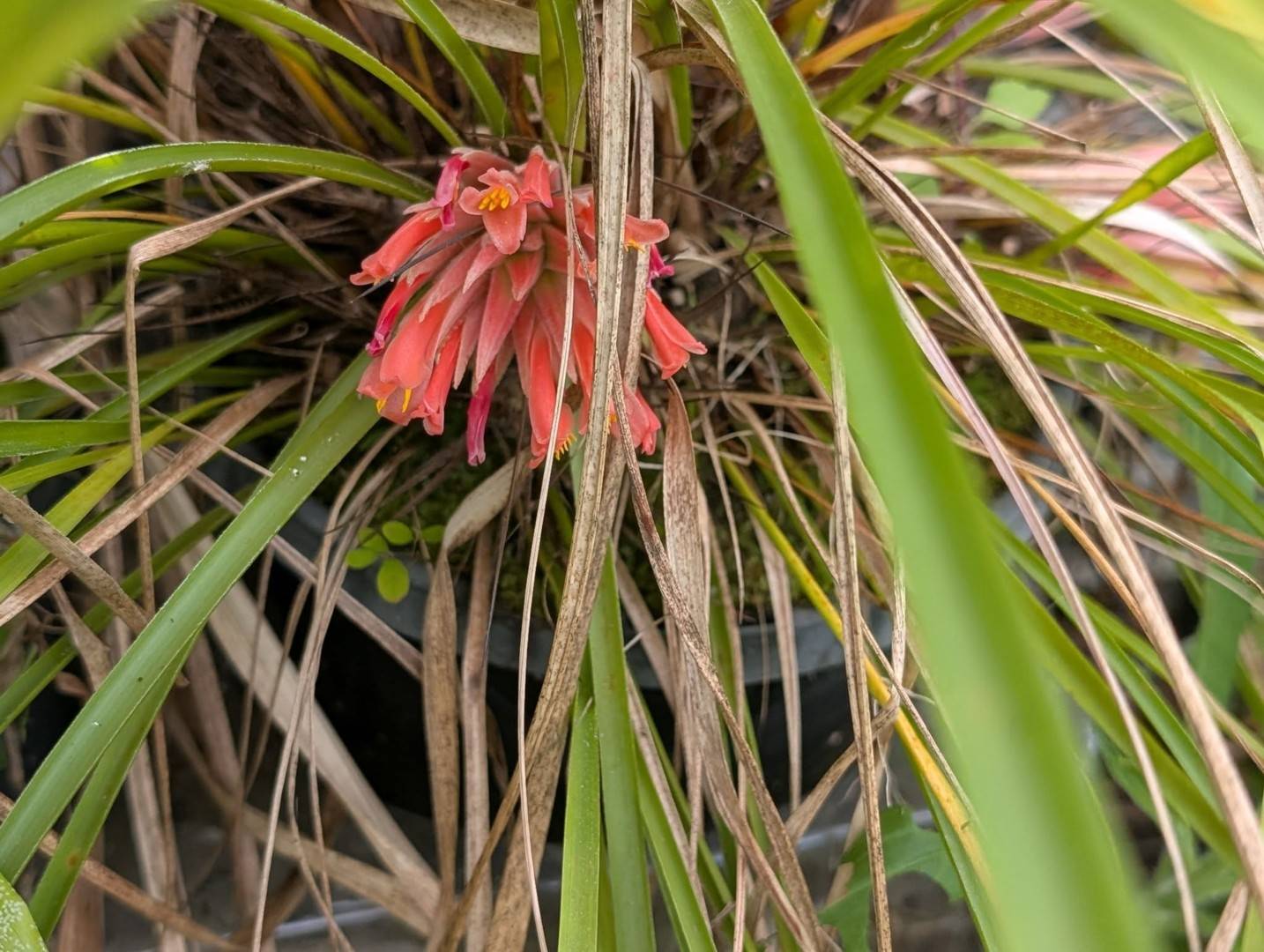
Pitcairnia heterophylla. This deciduous plant has 60cm long light green leaves. At the start of autumn, these leaves are shed and the plant consists of a small clump of brown, spiny "leaves". In spring, a cluster of flowers with pink to red or white petals appears at the end of a short stalk. As the plant is basically dormant in winter, be careful not to over-water it.
Pitcairnia imbricata. The light green leaves are up to 60cm long and 5cm wide. The inflorescence is a light-red cylindrical spike about 50cm long. The flowers are about 5cm long, while the petals are creamy-yellow.
Pitcairnia integrifolia. Leaves are 60 to 80cm long and up to 3cm wide. The leaves' upper surface is a dull green, with the under surface being covered with dense, grey scales. The branched inflorescence is about 50cm long and 30cm wide. The flowers are about 3cm long, and have petals that are yellow at their base and bright red at their tips.
Pitcairnia maidifolia. It has two types of leaves. The inner, green leaves are about 10cm wide, 30cm long, and occur at the end of long stalks, while the outer leaves are reduced to blackish "sheaths". Its yellow-green flower spike consists of a 20cm long elongated cluster of flowers, located on top of a 30 to 60cm long stalk. The flowers have white petals.
Pitcairnia nigra. The plant is about 80cm tall, with leaves up to 15cm wide. A cylindrical spike, which is 10 to 50cm long and 5 to 7cm wide, arises from a 20cm long stalk. The flowers have 10cm long petals that are yellowish-white at their base, and are black-purple at their tips.
Pitcairnia riparia. Individual plants occur on the ends of numerous, above-ground, branching, rhizome-like growths. Each plant consists of a semi-erect "tight" cluster of 5 to 10 leaves. Each of the light green leaves is about 40cm long and 1cm wide. The pendent infloresence consists of a spike having around 10 red-petalled flowers. This plant can be grown in a hanging basket.
Pitcairnia smithiorum. The species was botanically described only in 1991, and is one of the most spectacular pitcairnia. The arching, light green leaves are up to 80cm long and 5cm wide. An egg-shaped, reddish spike, which is about 10cm long and 7cm wide, arises from a 30 to 50cm long stalk. The spike is level with the top of the plant's leaves. The flowers have orange-yellow petals. Several beautiful hybrids have been made using this plant.
Pitcairnia tabuliformis. This plant has a very different appearance to the other piticairnias described in this article. About 20 green leaves, 15cm long and 7cm wide, form a flattened (table-like) rosette. About 40 flowers form a 5 to 7cm wide, "head-shaped" cluster in the plant's centre. The flowers' petals are orange-red. This is a rare plant.
Pitcairnia undulata. Its leaves are 15 to 20cm wide, 70cm long, pale green on top, and whitish-green on their lower surface. The red infloresence is about 30 to 45cm long, and consists of an elongated cluster of flowers that have red petals.
Pitcairnia xanthocalyx. This plant readily forms a large clump. The 100cm long leaves are up to 2.5cm in width. The leaves' upper surface is light green, while the lower surface is light grey. The many-flowered raceme, which is 50 to 70cm long, arises from a 60cm long stalk. The 2 to 5cm long petals are yellow.
If you only have space for a few Pitcairnia, I suggest you try atrorubens, heterophylla, nigra, and smithiorum. Colour photographs of over 50 pitcairnia, including many discussed in this article, appear in "Bromeliads" by Francisco Oliva-Esteve. This book can be borrowed from the Society's library. Colour photographs of pitcairnia, including the P. smithiorum hybrids mentioned previously, can also be seen on the Florida Council of Bromeliad Societies' website: www.fcbs.org
The best Pepinia to grow is P. sanguineav.
I thank Mike Symmons for his help in preparing this article, and Doug Upton for taking the photographs used to illustrate it.
Author Contact details: email: threereillys@bigpond.com.au , phone (07) 3870 8029"
Pitcairnia heterophylla var heterophylla forma heterophylla
Puya heterophylla Lindley, Bot. Reg. 26: pl. 71. 1840.
Puya longifolia C. Morren, Ann. soc. Agr. Bot. Gand. 2: 483, pl. 101. 1846. Type. Ghent Hortus s n (n v, typified by the plate).
Pitcairnia exscapa Liebmann, Ind. Sem. Hort. Haun. "1848": 12. 1848. Type. Mexico, Copenhagen Hortus s n (C, photo, US).
Pitcairnia lindleyana Lemaire, Jard. Fleur. 2: sub pl. 151. 1852; based on Puya heterophylla Lindley.
Pitcairnia morrenii Lemaire, Jard. Fleur. 3: pl. 291. 1852; based on Puya longifolia C. Morren.
Pitcairnia longifolia (C. Morren) Beer, Bromel. 67. 1857.
Pitcairnia liebmannii K. Koch, Ind. Sem. Hort. Berol. "1857," App.: 7. 1858; based on Pitcairnia exscapa Liebmann.
Hepetis heterophylla (Lindley) Mez, DC. Monogr. Phan. 9: 973. 1896.
Leaf-blades dimorphic.
Petals some shade of red.
TYPE. Parkinson in bb. Lindley s n (CGE, photo, GH), Mexico without locality, May 1840.
DISTRIBUTION. Saxicolous and epiphytic, dry cliffs to moist forest, 180-2300 m alt, Mexico to Venezuela and Peru.
MEXICO. SINALOA: San Ignacio, 16 June 1918, Montes & Salazar 400 (US, sterile); 17 Aug 1918, 488 (US, sterile). NAYARIT: Holcocotan to Tepic, 1 Nov 1925, Ferris 5765 (DS, US); Compostela, 12 Nov 1959, McVaugh & Koelz 499 (MICH). JALISCO: San Sebastian, Sierra Madre Occidental, 24 Jan 1927, Mexia 1564 (BM, DS, GH, MICH, US); Autlan to La Resolana, 12 Aug 1949, Wilbur 2295 (MICH, US); Autlan, 16 Nov 1952, McVaugh 14208 (MICH, US); 22-23 Nov 1959, McVaugh & Koelz 1016 (MICH); La Cuesta to Talpa de Allende, 19 Nov 1960, McVaugh 21173 (MICH). VERA CRUZ: Orizaba, Bilimek 443 (P); Botteri (GH, US); Bourgeau 2524 (GH, US); Fred. Mueller 1461 (BR, K, L); Tezonapa, Cordoba to Tierra Blanca, 1 Mar 1949, Carlson 1332 (US); Barranca de Texolo, Coatepec to Teocelo, 16 Apr 1952, Moore 6281 (BH, US). MEXICO: Nanchititla, Temascaltepec, 14 Mar 1933, Hinton 3604 (GH, K, US); 4-12 Dec 1954, Matuda 31994 (US). OAXACA: Tuquila, 29 Nov 1921, Conzatti 4357 (US, subscapose); Panixllahuaca to Tuquila, 25 Dec 1921, Conzatti 4528 (US). CHIAPAS: Mount Ovando, Dec 1936, Matuda 382 (US); Mitontik, San Cristbbal las Casas to Chenalo, 19 Apr 1965, Breedlove 9793 (US). WITHOUT LOCALITY: Kerber 237 (B). GUATEMALA. HUEHUETENANGO: Malacatancito to Huehuetenango, 4 Jan 1941, Standley 82182 (GH). BAJA VERAPAZ: Salami, 4 Dec 1890, Seler 2447 (GH), 22 Jan 1905, Maxon & Hay 3400 (US). QUEZALTENANGO: Zunil, 20 Jan 1896, Nelson 3688 (US); Santa Maria de Jesus, 11 Mar 1939, Standley 68250 (F); 31 Dec 1939, Steyermark 33259 (F). CHIQUIMULA: Amatillo, Volcan Ipala, 25 Oct 1939, Steyermark 30470 (GH); Concepcion de las Minas to Montana Nube, 1 Nov 1939, Steyermark 30973 (F, GH). JALAPA: Jalapa, 7 Jan 1908, Kellerman 8088 (F, US). GUATEMALA: Volcan Pacaya, 6 Jan 1907, Kellerman 6574 (US); Palin, 15 Jan 1938, J. R. Johnston 1206 (F); Finca La Aurora, 1938-39, 1. Aguilar 171 (F). SACATEPEQUEZ: Volcan de Fuego, Salvin & Godman s n (K); Embaulada, Dec 1891, Heyde & Gux 4632 (GH, US). WITHOUT DEPARTMENT: Santa Maria Ikibal, Bernoulli & Cario 683 (GOET, K). HONDURAS. MORAZAN: Hoya Grande, 23 Mar 1947, Williams & Molina 12233 (US). SALVADOR. AHUACHAPAN: Sierra de Apaneca, 17-19 Jan 1922, Standley 20111 (US); Laguna Verde, 30 Dec 1950, Rohweder 16 (HBG); 17 (HBG); Laguna de las Ninfas, 28 Jan 1951, Rohweder IS (HBG). SANTA ANA: Hacienda San Jose, 1 Dec 1950, Rohweder 13 (HBG); 14 (B); 15 (HBG); 23 Aug 1951, Rohweder 24 (HBG); Finca San Jorge, 4 Jul 1951, Rohweder 19 (B); 20 (HBG). LA LIBERTAD: Comasagua, Dec 1922, Calderon 1401 in part (US); Colina de Santa Tecla, Jul 1923, Calderdn 1401 in part (US). SAN VICENTE: Volcan de San Vicente, 7-8 Mar 1922, Standley 21604 (US); 25 Jul 1951, Robweder 21-23 (HBG). NICARAGUA. MATAGALPA-JINOTEGA: Matagalpa to Jinotega, 1 Apr 1961, Bunting & Licht 991 (US). MANAGUA: Casa Colorada, 27 Jun 1923, Maxon, Harvey & Valentine 7365 (US); Managua, Apr 1932, Garnier 780 (US). WITHOUT LOCALITY: Tate 414 (BM); 415 (BM). COSTA RICA. GUANACASTE: Los Ayotes, Tilaran, 21 Jan 1926, Standley & Valerio 45594 (US). SAN JOSE: Mountain south of San Jose, 2 Feb 1878, Lehmann 9 (W); San Francisco de Guadalupe, Apr 1894, J. D. Smith 4959 (US); Jan 1896, Tonduz 7185 (US); San Isidro Coronado, Feb 1924, Alfaro 34010 (US); San Jose, Feb 1924, Standley 33239 (US); Santa Maria de Dota, Dec 1925, Standley 42093 (US); El General, Dec 1936, Skutch 3105 (GH, US). WITHOUT LOCALITY: Inst. Costar. 1961 (BR); Tonduz 7302 (BR); Hoffmann 568 (B); Pittier 10600 (US). PANAMA. CHIRIQUI: Cerro de Lino, above El Boquete, 5 Mar 1911, Pittier 3033 (US); Cerro Vaca, eastern Chiriqui, 25-28 Dec 1911, Pittier 5373 (BM, US). COCLE: El Valle de Anton, Hunter & Allen 364 (GH). CANAL ZONE: Barro Colorado Island, 1931, Aviles 61 (F); Caiion of Rio Chagres, Dodge & Allen 17467 (GH). WITHOUT LOCALITY: Seemann 1564 (BM)`.' COLOMBIA. GUAJIRA-MAGDALENA: Pueblo Viejo to Paramo de Macotama, 10 Feb 1959, Barclay & Juajibioy 6868 (COL, US). MAGDALENA: Manare, 16 Jan 1944, Haught 3954 (GH, US); Santa Marta, 29 Jul 1946, Foster & Smith 1322 (GH); San Sebastian, Sierra Nevada de Santa Marta, Aug 1946, Foster & Smith 1457 (GH); St. Sogrome Valley, 1954, College of the West Indies 48 (US). NORTE DE SANTANDER: Sarare, Rio Chitaga, 14-17 Oct 1941, Cuatrecasas, Schultes & Smith 12213 (US). ANTIOQUIA: Penol, Daniel 3413 (US). CUNDINAMARCA: Puente de Quetame, Andre 1087 (K); Dec 1939, Perez-Arbelaez 10098 (COL); 17 Dec 1950, Schneider 1027 (COL). CAUCA: Rio Sucio, Cerro de Engruma, 1844, Goudot s n (P). VENEZUELA. ANZOATEGUI: Bergantin, 21 Feb 1945, Steyermark 61065 (VEN); 24 Feb 1. 945, 61165 (GH, US, VEN). DISTRITO FEDERAL: La Guaira, Moritz 75 (! Mez); Sebucan, Caracas, Moritz 251 (BM); 1865, Ernst 227 (BM); Los Castillitos to Boca de Tigre, 5 Mar 1950, Trujillo & Fernandez 977 (VEN); Avila, Mar 1958, Aristeguieta 3018 (VEN). ARAGUA: Maracay, 1934, C. Vogel 1066 (M); 1076 (M); Maracay to Choroni, 9 Feb 1953, Schnee 1270 (VEN). CARABOBO: Valencia, Jan 1920, Pittier 8748 (GH, US). LARA: Arispero, Guarico, 2 Jan 1948, Tamayo 3415 (VEN). ZULIA: Perija, 1 Jan 1951, Gines 2038 (US). MERIDA: Merida, 19 Feb 1957, Bernardi 6248 (MERIDA). BOLIVAR: Chimanta-tepui, Torono-tepui, 30-31 May 1953, Steyermark 75608 (US); Auyan-tepui, Apr 1956, Vareschi & Foldats 4818 (VEN). AMAZONAS: Cerro de la Neblina, Rio Yatua, 27 Dec 1953, Maguire, Wurdack & Bunting 36940 (NY, US). WITHOUT STATE: Terepaima, 24 Jan 1954, Trujillo 1965 (VEN). ECUADOR. MANABI: Noboa, 23 Jul 1942, Haught 3421 (GH, US). ORO: La Chorita to Zaruma, 28 Aug 1923, Hitchcock 21190 (GH, US); Guapacasa to Zaruma, 30 Aup 1947, R. Espinosa E-1888 (US). PICHINCHA: Rio Blanco, Santo Domingo, Lehmann 4468 (K). BOLIVAR: Balsapamba, Sep 1937, Rimbach 861 (F, S). CHIMBORAZO: Huigra, 17 Aug 1918, Rose 22155 (GH, US); Huigra to Naranjapata, 17 Jul 1923, Hitchcock 20681 (GH, US); Sibambe, 18 Aug 1943, Acosta Solis 5395 (F); Rio Chanchan, Naranjapata to Huigra, 19 Jun 1945, Camp E-3888 (NY, US). CANAR: ca 100 km from Guayaquil to Cuenca, Jul 1963, Gilmartin 926 (US); km 128, 13 Aug 1965, Gilmartin 1168 (US). LOJA: Chinchanga, Poortman in Andre 476 (K); Chincha, San Pedro to Zaruma, 30 Jul 1939, Penland & Summers 1167 (GH); Catacocha, 4 Jul 1946, R. Espinosa E-595 (GH); San Pedro to Portovelo, 13 Oct 1955, Asplund 18136 (S, US); San Pedro to Zaruma, 29 Jul 1959, Harling 6136 (S, US). PERU. PIURA: Tambo to Canchaque, 18 Sep 1964, Hutchison & Wright 6658 (UC, US); Canchaque, Rauh s n (US). CAJAMARCA, Hualgayoc: Monte Seco, Aug 1949, Soukup 3847 (US).
Pitcairnia heterophylla var heterophylla forma albiflora Standley & Smith, Lilloa 6: 383. 1941.
Pitcairnia exscapa Hooker var albiflora Grisebach, Nachr. Ges. Wiss. Goett. 1864: 14. 1865; nomen, based on Fendler 1520.
Leaf-blades dimorphic.
Petals white.
TYPE. Standley 58302 (holotype, F; isotype, GH), Las Lojas, Sacatepequez, Guatemala, 28 Nov 1938.
DISTRIBUTION. Sporadic over the same range as the typical form.
MEXICO. MEXICO: Temascaltepec, 15 Jan 1937, Hinton 9964 (GH, US). GUERRERO: Plan de Carrizo, Galeana, 12 Oct 1937, Hinton 11027 (GH, US); Mazatlan, 27 Dec 1947, Correll 14388 (US). COSTA RICA. SAN JOSE: El General, Feb 1936, Skutch 2550 (GH, US). VENEZUELA. ARAGUA: Colonia Tovar, Fendler 1520 (GH, GOET).
Pitcairnia heterophylla var exscapa Mez, DC. Monogr. Phan. 9: 375. 1896.
Pitcairnia cernua Kunth & Bouche, Ind. Sem. Hort. Berol. "1848:" 12. 1848. Type. Guatemala, Warsczewitz in Berlin :Yortus (n v).
Pitcairnia exscapa Hooker, Bot. Mag. 77: pl. 4591. 1851, non Liebmann, 1848.
Hepetis heterophylla var exscapa (Mez) Mez, DC. Monogr. Phan. 9: 973. 1896; incorrectly attributed to Hooker.
Leaves all alike, spinose at base.
Petals red.
TYPE. Kew Hortus s n (in the absence of any specimen adequately typified by Botanical Magazine pl 4591), Colombia.
DISTRIBUTION. Guatemala and Colombia. Known from cultivation only as noted above. The wild material cited by Mez is either dubious or else belongs to the typical variety.
Puya heterophylla Lindley, Edwards Bot. Reg. 26: pl. 71. 1840. TAB 71
PUYA heterophylla.
Various-leaved Puya.
HEXANDRIA MONOGYNIA.
Nat. Ord. BROMELIACEAE.
PUYA. Botanical Register, 1840. fol. 11.
A. heterophylla; bulbosa, folus primordialibus basi coriaceis concavis dilatatis sursum subulatis corneis spinosis serratis; secundariis teneris lanceolatis inermibus multo longioribus parcissime pruinosis, spica simplici sessili imbricata. foliis multo breviore, bracteis lanatis calycibus brevioribus.
Sepala lineare-lanceolata, cornea, acuminata, carinata, sublanata, petalis breviora. Petala carnea, ligulata, convoluta, basi squama duplici serrata instructa. Stamina 6, basi perianthii inserta; antheris linearibus. Ovarium basi immersum, maxima pro parte liberum, triangulare, pyramidatum, 3-loculare, polyspermum; stylo filiformi; stigmatibus convolutis.
A very pretty plant, evidently belonging to the genus Puya, and most remarkable for bearing two kinds of leaves. Those at the base of the plant arise from tough; concave, broad, horny petioles, which overlie each other, forming a kind of bulb, and are extended into narrow, hard, serrated, spiny, brown processes about two inches long. The leaves, on the other hand, which are last formed, are thin, lanceolate, bright green, and more than eighteen inches long when full grown, and bear no resemblance to the first. The flowers are arranged in a close, oblong spike, composed of imbricated woolly cartilaginous pale, green bracts, occupying the centre of a bulb of spiny leaves in the place of the thin leaves before mentioned.
I am indebted for my knowledge of it to John Rogers, Esq. Jun, of Sevenoaks, with whom it flowered in May 1840, and who has given me the following memorandum concerning its history and habits.
"I received the plant from Mr. Parkinson from Mexico, in 1838, and stuck it into a pot loosely filled with Tillandsia, in which this plant and the Epiphytes which accompanied it had been packed. It flourished so well in its temporary abode, the roots clothing the inside of the pot, that I never disturbed or planted it otherwise; and this summer it flowered for the first time. When growing it has received abundance of water; indeed I believe it stood in a pan always full.
When the leaves began to turn yellow, it was set on the floor of the house and kept dry and cool for two months or more till it showed flower. It has been grown close to the light, in a stove of moderate temperature, not very damp.
Its spiny processes are excessively sharp and brittle, rendering it almost dangerous to touch the plant; and the leaves when full grown are eighteen inches to two feet long, and flexible, hanging about more loosely than those of most similar plants."