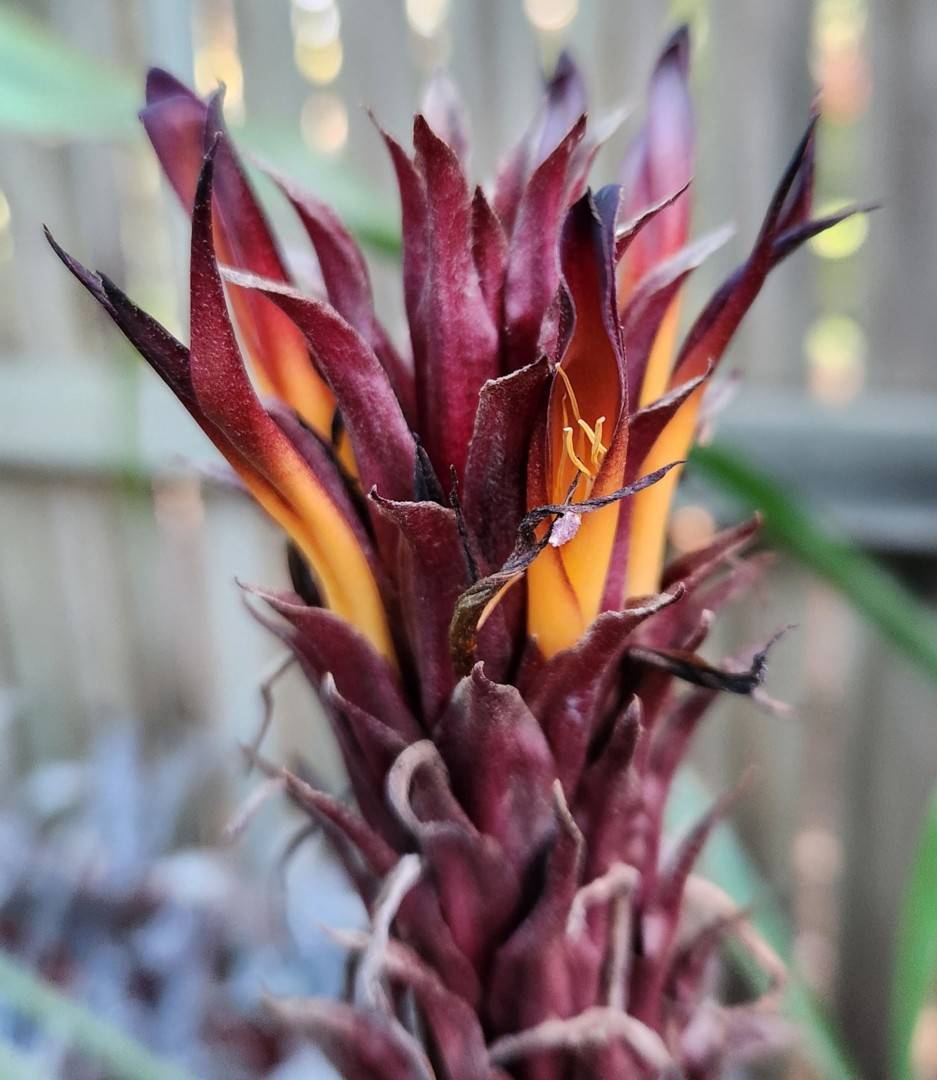
Plant stemless, epiphytic, lithophytic, or terrestrial, flowering to 1 m tall.
Leaves 10-15, isomorphic, rosulate, erect, 12-15 dm long.
Sheaths small {measurement not specified}, triangular-ovate, entire, dark castaneous, densely brown-lanate.
Petioles slender, canaliculate, densely brown-lanate, 3-4 dm long and 8-10 mm wide, laxly serrate with small, dark, recurved spines.
Blades linear lanceolate, acute to long-attenuate, 9-11 dm long and 5-8 cm wide, entire except at the base, glabrous.
Scape erect, stout, 1-1.5 cm in diameter, densely brown-lanate.
Scape bracts strict, imbricate, much exceeding the internodes, the lower subfoliaceous but not petiolate, green, the upper broadly elliptic, acute, 7-9 cm long and 2-3 cm wide, entire, chartaceous, densely brown-lanate, reddish brown.
Inflorescence simple, erect, stoutly cylindric, truncate, 25-35 cm long and 7-10 cm in diameter, much exceeded by the leaves.
Floral bracts elliptic with a reflexed, triangular apex, 55-85 mm long and 20-30 mm wide, entire, densely brown-lanate, reddish brown.
Flowers erect, subsessile.
Sepals narrowly oblong, acute, slightly asymmetric, mucronate, 35 mm long and 6 mm wide, posteriorly carinate, dark castaneous at extreme base, densely brown-lanate, light brown, much exceeded by the floral bracts.
Corolla zygomorphic, recurved.
Petals linear, broadly acute, 80 mm long and 7 mm wide, unequal, bearing two bidentate appendages at base, sparsely white-lepidote, dark maroon.
Stamens included, 65 mm long.
Filaments free, linear, 50 mm long and 1 mm wide.
Anthers sagittate, 15 mm long and 2 mm wide, dorsifixed, yellow.
Style terete, elongate, 55 mm long and 2 mm in diameter.
Stigma 5 mm long, lobes unequal, loosely spiraled.
Ovary conical, 10 mm long and 4 mm in diameter, 3/ 4 superior. Ovules numerous, caudate.
Type: V. Funk 10189. Holotype, CR; isotype US). Costa Rica. Alajuela Province: northeast side of Volcan Arenal on the Rio Tabacon flow, growing in dwarf forest on approximately 500-year old block lava flow with individual lava blocks still intact, 8 May 1987
Other specimens examined: Costa Rica: Alajeula Province, 3.5 km west of Fortuna, 2.5 km northwest of New Volcan Arenal along sloping base, elev. 1,500 m, 5 Aug. 1972, J. & C. Taylor 116038 (US); northwest slope of Volcan Arenal, Rio Tabacon flow, low open forest on large lava blocks, 28 May 1985, V. Funk, W. Melson & J. Funk 6963 (US); slopes of Volcan Arenal between Fortuna and Palma, old lava fields with dense, dwarf forest, elev. 650 m, 25 July 1990, Luther, Skotak, & Bak 2812 (SEL, MO, CR).
Relationships: Based on the classification system of Smith and Downs (1972), Pitcairnia funkiae most closely resembles P. atrorubens (Beer) Baker but can be readily distinguished from that species by its basally serrate leaf blades, stoutly cylindric, truncate inflorescence, densely brown-lanate sepals and floral bracts, and dark maroon petals. In P. atrorubens the leaf blades are entire, the inflorescence is more slender and suspicate, the sepals and floral bracts are glabrous, and the petals are yellow to cream.
Etymology: This new species is named in honor of the collector, Dr. Vicki A. Funk, Curator of Botany, Smithsonian Institution.
Notes
Volcan Arenal is one of seven active volcanoes in central Costa Rica. In 1983, the Smithsonian Institution, in collaboration with the Instituto Nacional de Biodiversidad of Costa Rica, initiated a project to study the volcanology and biology of that volcano. One aspect of the project was to study the flora. While examining Bromeliaceae specimens that she had collected, Dr. Vicki Funk, a curator at the Smithsonian, discovered a new species of Pitcairnia.