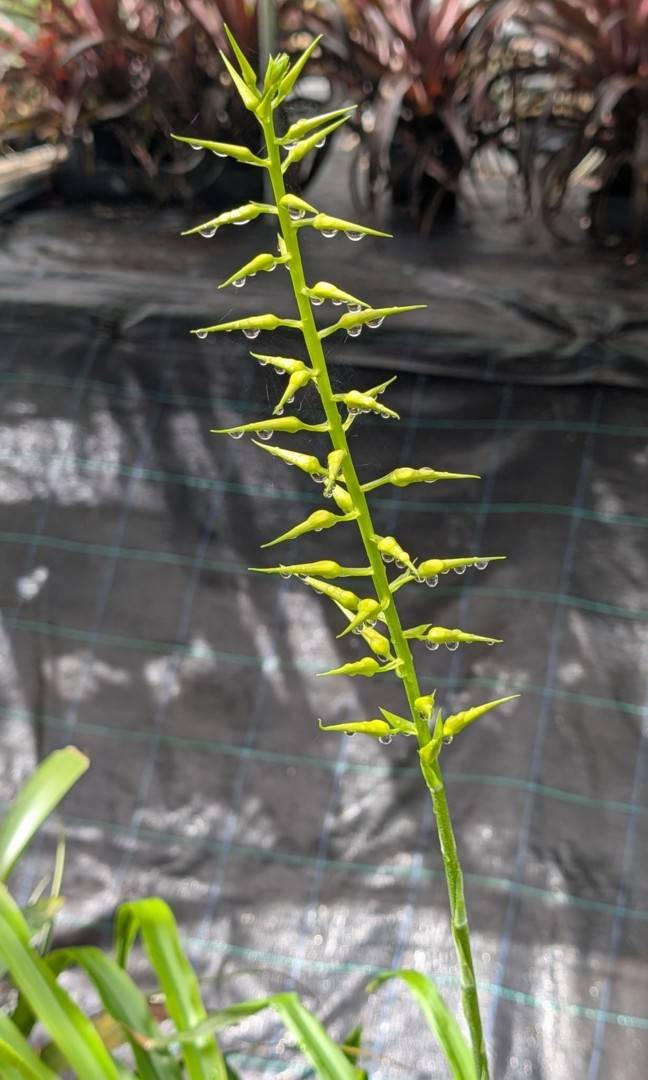
Pitcairnia echinata var echinata
Hepetis echinata (Hooker) Mez, DC. Monogr. Phan. 9: 973. 1896.
Sepals and base of ovary densely and coarsely echinate with processes 1-2 mm long;
petals white.
TYPE. Kew Hortus s n (holotype, K; photo, GH), cultivated, supposedly from Mexico, but not likely.
DISTRIBUTION. Terrestrial and saxicolous in open situations, 200-1300 m alt, northern Colombia and adjacent Venezuela.
COLOMBIA. CUNDINAMARCA: Fusagasuga, Holton 152 (K); La Mesa, Bogota, 1851-57, Diana s n (BM); Zipaquira, 20 Mar 1955, Huertas & Camargo 1029 (F); Cambao road near "La Rioja," 20 Mar 1955, Fernandez & Jaramillo-M 2870 (COL, US). TOLIMA: Ibague, 1844, Goudot s n (P). VENEZUELA. TACHIRA: Ayari, 27 Aug 1966, Steyermark & Rabe 96640 (US, VEN).
Pitcairnia echinata var. sublaevis L. B. Smith, Contr. U. S. Nat. Herb. 29: 304. 1949.
Sepals and base of ovary minutely and sparsely stellate, nearly even.
TYPE. Foster 1889 (holotype, GH), on rocks along river, Pandi, 900 m alt, Cundinamarca, Colombia, 13 Oct 1946.
DISTRIBUTION. Known from the type collection only.
Pitcairnia echinata var vallensis L. B. Smith, Phytologia 4: 378. 1953.
Petals rose-orange;
stamens exserted.
TYPE. Cuatrecasas 22963 (holotype, F), on lomas of Cuchilla de Santa Barbara, Cartago, Valle, Colombia, 17 Nov 1946.
DISTRIBUTION. Terrestrial, 1140-1300 m alt, Valle, Colombia.
COLOMBIA. VALLE: Rio Bugalagrande, Jun 1930, Dryander 436 (US, petal color not wholly certain).
PITCAIRNIA ECHINATA. Hooker, Bot. Mag. 79: pl. 4709. 1853.
TAB. 4709.
Echinated-flowered Pitcairnia.
Nat. Ord. BROMELIACEAE – HEXANDRIA MONOGYNIA
Gen. Char. (Vide supra, TAB. 4241.)
PITCAIRNIA echinata; foliis radicalibus elongatis lanceolatis acutissimis striatis subtus parce farinosis spinuloso-serratis inferne attenuatis semicylindraceis (magis spinosis), caule parce folioso longissimo pulverolento-tomentoso apice laxe racemoso-paniculato multifloro, sepalis setis mollibus flavo-virescentibus apice uncinato-glandulosis echinatis, petalis (albis) calycem fere duplo superantibus, staminibus styloque inclusis.
A well-marked species of Pitcairnia, received from Mr. Linden, under the name of "Pourretia", probably from Mexico, but of the locality we can only conjecture. In no work can I find any such plant described, either under Pourretia or Pitcairnia, or any allied genera, the limits of which we must confess are at present very ill-defined. I see no reason however for considering this other than a true Pitcairnia, as the genus is usually considered, It threw up its fine flowering-stems in January 1853, and continued a long time in blossom.
DESCR. In a flowerless state this plant may be considered stemless; the leaves being all radical, as in the common Pine-apple, very long, two to three feet, elongato-lanceolate, very acuminate; carinate, striated, rather full green and glabous above, beneath pale-coloured and floccoso-farinose, the margin is serrato-spinulose, but not very strongly so, except towards the much-attenuated, conduplicate and almost sheathing, yellow-brown base, where the spines are much longer, very numerous, and crowded, and curved upwards. As the flowering-season approaches, a stem is thrown up from the centre, which elongates, bearing few and gradually smaller leaves, till it forms the almost leafless base of the slightly compressed, terminal raceme, when the leaves insensibly become bracteae. The scape is everywhere pubescenti-furfuraceous, terete. Pedicels about an inch long, supported by an ovate, acuminate, concave, membranaceous bractea, ciliated at the edge, and about equal to the pedicel in length. Flowers pendent, large. Calyx of three, long, slightly twisted, linear-oblong, attenuated, deeply canaliculate sepals, broader and red at the base, the rest full yellow, and everywhere clothed (except at the membranous overlapping edges) with soft, copious, spinelike, horizontal processes, uncinate at the apex: the shortest and least uncinate are at the base of the sepals, those at the extremity are tipped with a pencil of hairs. Petals white or cream-colour, more than half as long again as the sepals, slightly twisted, linear-subspathulate, slightly concave below the point, with no internal scale at the base. Stamens included, a little shorten than the petals. Ovary pyramidal, three-furrowed. Style as large as the stamens. Stigmas three, spirally twisted.