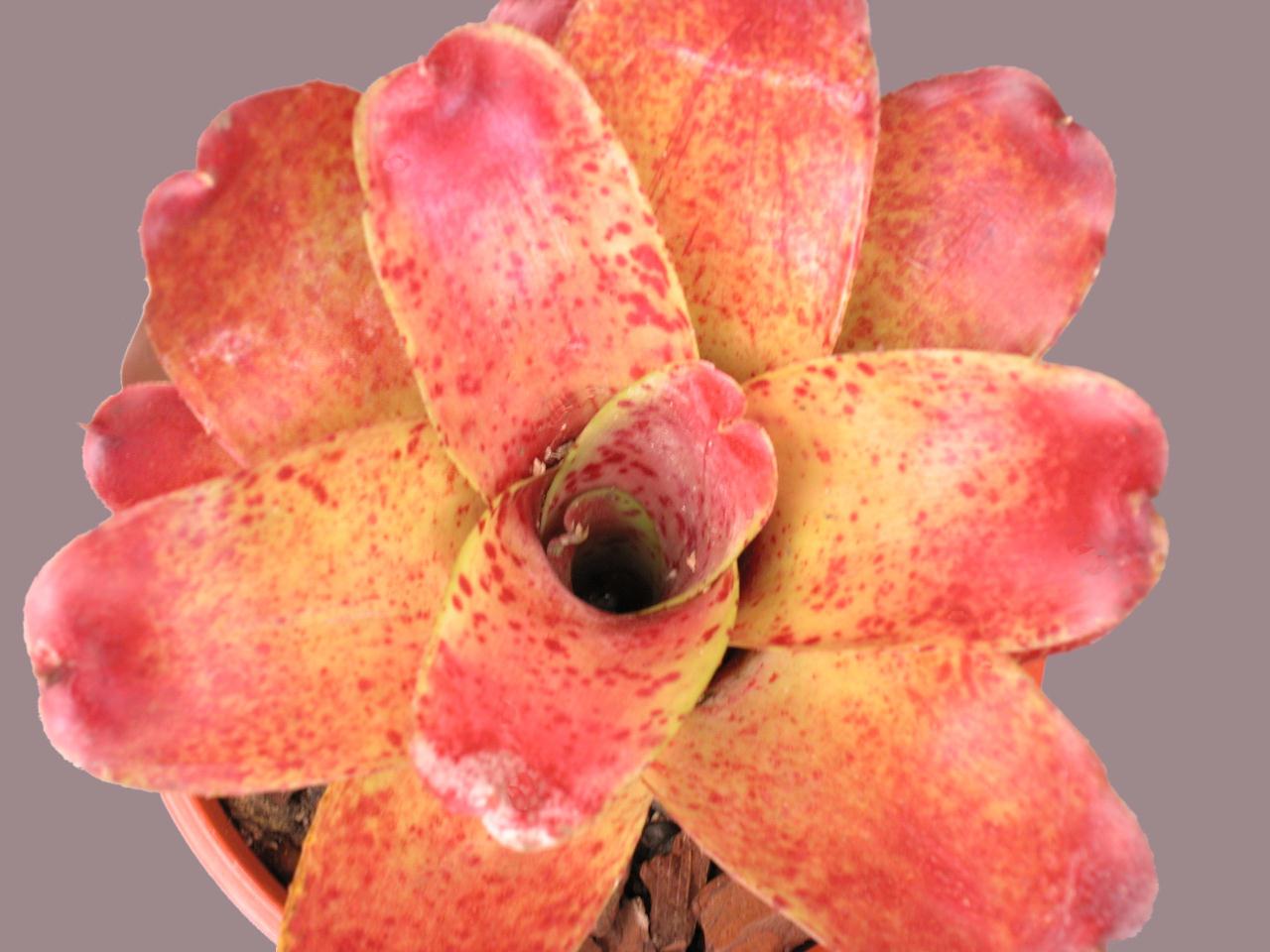
Neoregelia Fancy Free Click thumbnails for full size, scaled to a new window.
Neoregelia Fancy Free BCR ... "cvs. from a very variable grex of hybrids from plants selected by Carrone and named marmorata 'Red Variety' X carolinae 'Extra Special' - many of which exhibited 'total color' from base to tips - grex has extreme variety. (Cvs. = 'Full Reward', 'Strawberry Ripple', 'Pink Chiffon' & 'Copper Queen'). Reg. Doc. 1977, JBS 27:250,265ill; 28:17ill-19, Baensch 126ill, ColorBroms 97ill, PineapplePl 81" marmorata 'Red Variety' x carolinae 'Extra Special' by J.Carrone, Louisiana USA, 1973.
Vic Przetocki
Ian Hook 12/25 Overcooked !
Neoregelia 'Fancy Free' - A New Hybrid Of Great Beauty by JOSEPH F. CARRONE, JR. in Journ Brom Soc 28(1): 17-19. 1979
It often happens that I will desire to make a certain cross but will be prevented from doing so because the blooming seasons of the two proposed parent plants will not coincide, or because one plant will not yet be mature enough to bloom when flowers are already available in the cup of the other. It was precisely because of these problems that this cross was only contemplated for nearly two years before it was made.
In 1973, as the blooming season of Neoregelia carolinae, 'Extra Special' was approaching, I treated with calcium carbide the lovely Neoregelia marmorata hybrid that I refer to as 'Red Variety'. The treatment was timed beautifully - both plants bloomed simultaneously, and I pollinated dozens of flowers on each plant with pollen from the other.
On July 23, 1973, I planted the first lot of seeds. I believe that every seed germinated and grew like grass. Indeed it could be seen from the start that this was a happy union! And within a year, over 150 plants with leaves over a half inch wide were planted into individual 2 1/4 inch pots. No two plants seemed to be the same color!
As the months passed, I noted that there were reds and red-purples of every shade and intensity, hot orange-reds, reds, and red-purples with green or orange spots in the leaves, etc. There were also several plants that were barred with green and red. Others were red to red-purple with distinct black or green edges on the leaves. There was no end to the variations.
As the cross approached two years of age, I noticed that many of these plants showed what I began to refer to as "total color". By this term I mean color from the very base of the plant right up to the leaf tips - and this color remained both winter and summer. Those marked with "total color" constituted nearly 40% of the whole cross. At two years old in May, 1965, six plants bloomed. Two were marked "total color" and varied only slightly in color. They were deep purplish red all over with a very deep fuchsia cup that seemed to blend into the overall leaf color without any clear line of demarkation. One plant was a clear rose-pink with a deeper rose-colored cup. Another had leaves of a hot orange-red color with the oldest leaves bleaching to pale green. Cup color was most unusual in that it had irregular white and yellow areas spread throughout the scarlet cup. Another was a lovely soft rose-colored plant with a deeper rose cup with many white dots throughout, just as if a light snow had fallen onto it.
By May, 1976, over 75% of these plants were in bloom. Because there were so many variations within this cross, I was perplexed at having to decide on a name that could embrace so wide an array of differences.
Under the present rules for registering this or any cross, all plants resulting from the same two parents must be given but one name. If I am to follow the rules, rather than do the prevailing wrong of giving only cultivar names to individual selections, I had to find a name that would be valid for every plant in the cross. After much thought, I finally arrived at the name, Neoregelia 'Fancy Free'. This name has been well accepted.
Selections have been made, of course, to be given distinct cultivar names. We have such cultivars as Neo' 'Fancy Free" cv. 'Full Reward'; Neo 'Fancy Free' cv. 'Pink Chiffon'; Neo 'Fancy Free' cv. 'Strawberry Ripple'; Neo 'Fancy Free' cv. 'Copper Queen'; etc
Plants are very full-leaved and they range from an eight-inch spread to nearly fifteen inches across. Leaf width is from two to two and one half inches.
I do believe that color selections from this one cross could be used in a decisive breeding program to arrive at just about any color in the spectrum. Within two generations, I do believe, plants with leaf color in clear orange, yellow-orange and even the deepest of blue-violet and true purple could be bred from this cross without adding to its gene pool from among outside sources.
Presently, a repeat cross of Neo. 'Fancy Free' using the exact same parents is in small pots and ought to bloom by the Summer of 1978.