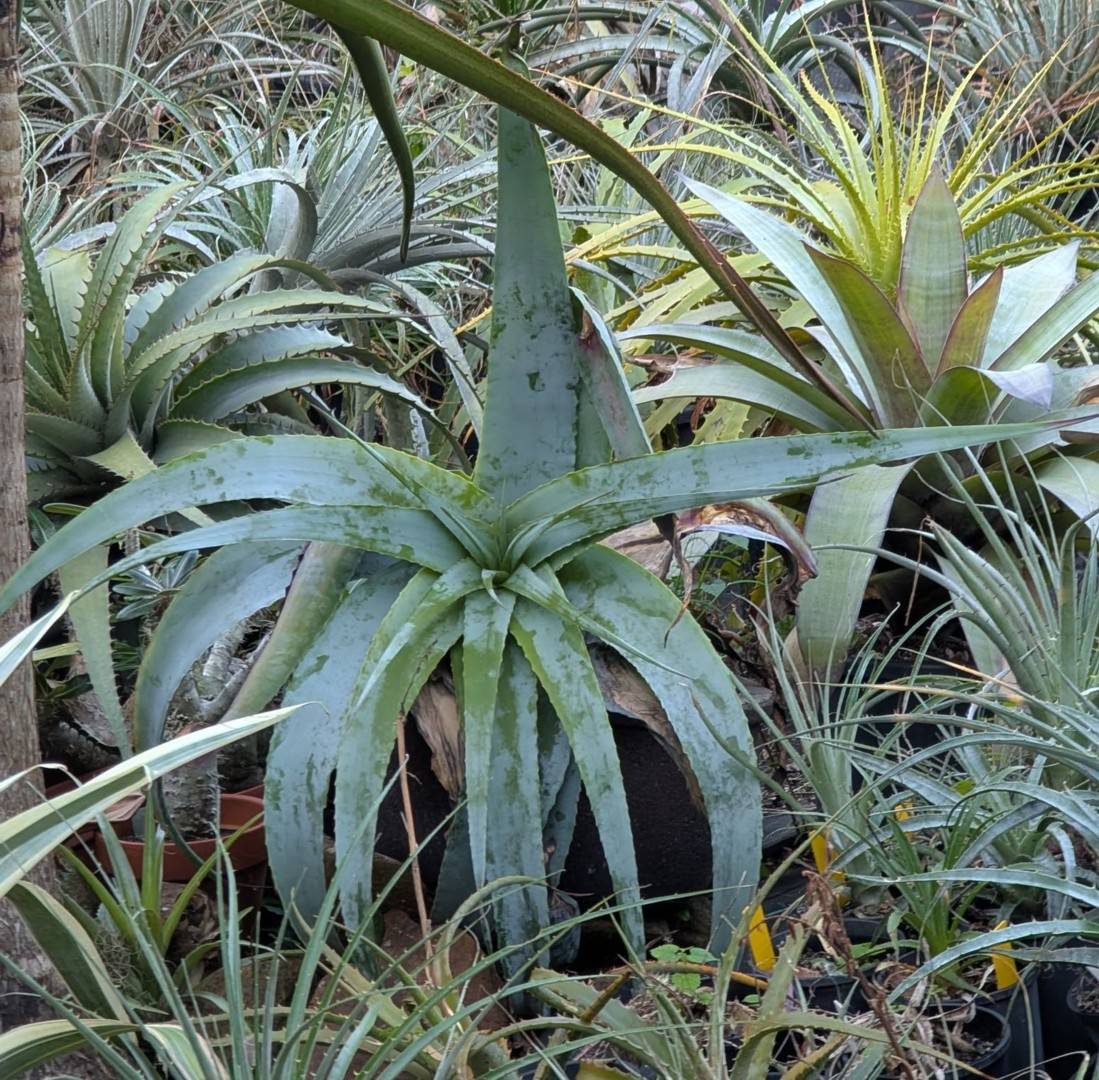
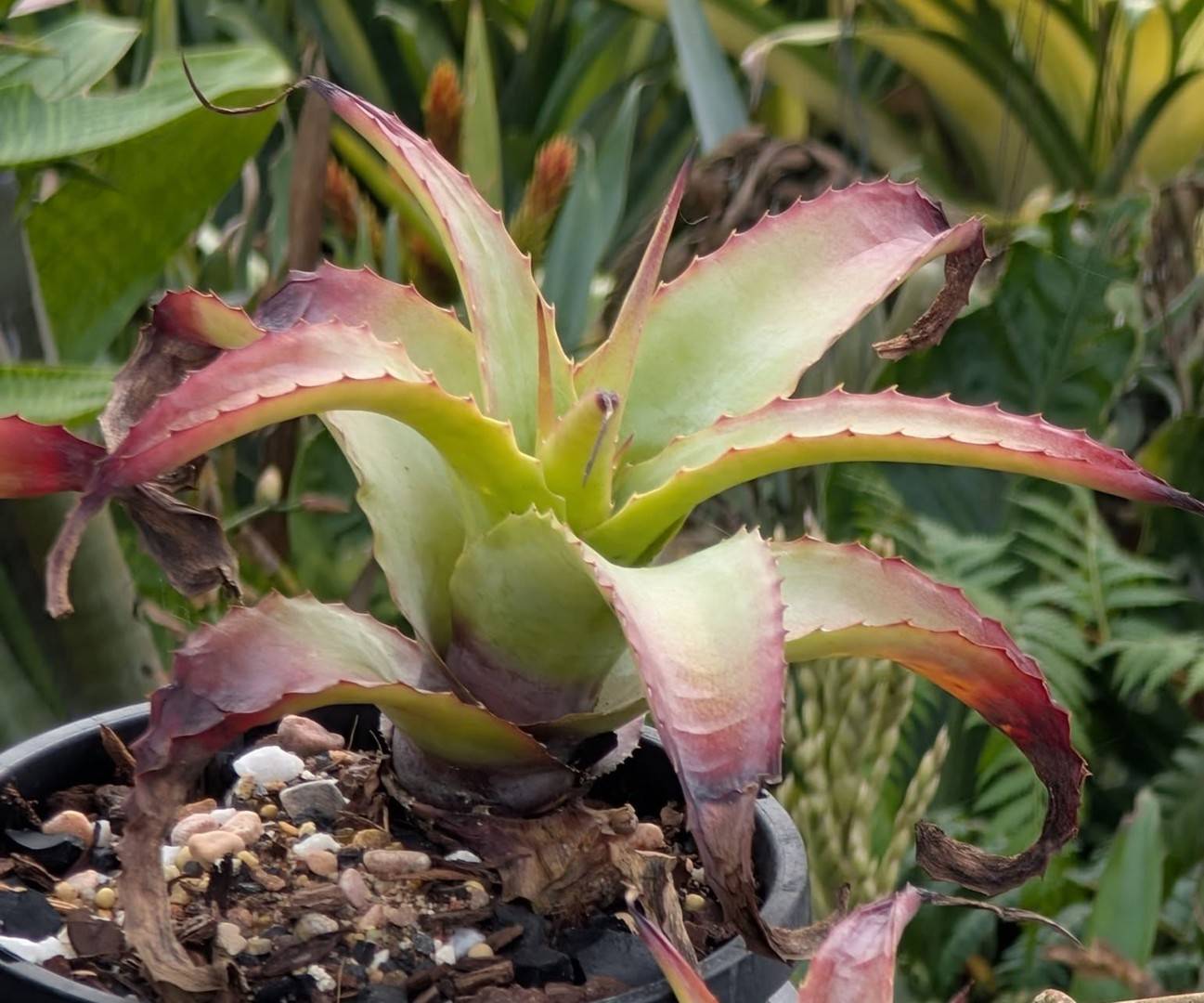
Plants in flower with rosettes to 7.6 dm diam. and inflorescences 9.4-14.5 dm high, usually solitary or in clumps of few individuals.
Leaves in strongly spreading rosettes, frequently falcate, 33.5-68 cm long;
sheaths somewhat inflated on older leaves, transversely elliptic to reniform, 4.5-6.7 x 6.5-11 cm, marginally crenulate to weakly spinulose, both surfaces glabrous and lustrous becoming glaucous distally, stramineous but older bases castaneous when dry, before drying often deep pink-red distally at the sheath-blade junction;
blades strongly recurved distally, broadly triangular, 5.8-9.3 cm wide, glabrous above and below except for tufts of uniseriate trichomes in axils of spines, usually with a fine waxy covering throughout above and below giving the blade a blue-green color, occasionally suffused pink, distally the margin armed with antrorse red-brown spines 0.7-2.7(3) cm apart and 0.8-2.5(3) mm long, but proximally the margin often crenulate with inconspicuous spines.
Inflorescence terminal, in both staminate and pistillate individuals subcylindric, glabrous, in the staminate weakly twice-compound, 13-15 cm diam., in the pistillate once-compound or rarely twicecompound, 11-23 cm diam.;
scape 40-75.5 cm x 0.8-1.2 cm, the internodes 0.9-3.5 cm long, glabrous;
lowermost scape bracts foliaceous, greatly exceeding the internodes, the remaining scape bracts becoming progressively reduced distally and shorter than to exceeding the internodes, ovate-triangular with linear, glabrous blades, 0.9-17.5 cm long; rachis 5.4-10.7 dm long;
primary bracts similar to upper scape bracts, ovate. triangular with linear blades, 0.4-1.7 cm long, much shorter than lateral branches and shorter than the sterile bases of branches, proximally erose;
lateral branches laxly many-flowered, proximally flattened, those of staminate inflorescences ascending to suberect, 6.5-17.5 cm long, but those of pistillate inflorescences spreading to subascending, 4.5-17.5(35) cm long.
Pedicels articulated with the rachis.
Staminate flowers spreading, often appearing subsessile;
floral bracts exceeding the pedicels but shorter than the sepals, broadly ovate, convex, 1.2-2 x 1.5-1.7 mm, apically apiculate to attenuate-acuminate, marginally very finely denticulate to erose;
pedicels stout and short, 0.3-1.2 mm long;
sepals 3, imbricate, subequal, ovate to broadly ovate, 1.6-2.2 x 1.5-2.3 mm, apically rounded to acute or apiculate, rarely praemorse, marginally entire or rarely somewhat erose, glabrous, light green or green suffused pink;
petals 3, postanthesis appearing subspathulate, 4.5-5 x 1.8-2.2 mm, apically rounded, white to light lavender pink; ovary rudimentary.
Pistillate flowers spreading to reflexed;
floral bracts shorter than the pedicels at anthesis, ovate, weakly convex, 1-2.3 x 1-1.3 mm, apicaily acuminate to apiculate, marginally erose distally;
pedicels (2) 2.5-4.5. mm long;
sepals 3, basally weakly imbricate, equal, triangular to ovate-triangular, 1.7-2.5 x 1.42 mm, apically apiculate to acute or acuminate, marginally entire or somewhat erose, glabrous, colored like the staminate sepals;
petals 3, spreading, triangular, 3.5-5 x 1.3-2.1 mm, apically acuminate to apiculate, white to faintly or deeply suffused dark lavender pink;
stamens rudimentary;
ovary largely superior, light green to light green suffused with pink.
Capsules with pedicels 3-5.5 mm long, loculicidally and septicidally dehiscent, ovoid, (8)9-12 x 3.5-5 mm, glabrous, castaneous, smooth.
Additional specimens examined: MEXICO. Michoacan: steep, exposed rocky cliffs, 900-1000 ft, 21, Jul 1990, Utley. Utley & Garcia M. 8529 (MEXU); 9 Mar 1980, Leuenherger & Schiers 1687 (B).
Distribution: Infrequent, but locally abundant on steep, exposed rock faces.
Hechtia glauca is a striking species which is immediately distinguishable from all other species of Hechtia by its broad, glabrous, glaucous leaves with irregularly ribbed abaxial leaf surfaces. Trichomes have been observed throughout the juvenile foliage of small seedlings, but only in axils of spines on leaves of older individuals. Unlike the peltate trichomes with conspicuous shields associated with leaf surfaces of Hechtia and most other taxa within the subfamily (Varadarajan & Gilmartin, 1987) or family (Tomlinson, 1969), those in axis of spines consist of a series of stalk cells which generally terminate in two uniseriate hairs. Although several other Hechtia species have apparently glabrous adaxial leaf blades, no other species that we have examined or collected has glabrous abaxial surfaces. Tomlinson (1969) characterized the Hechtia abaxial epidermis as ribbed, resulting from prominent costal bands separated by intercostal furrows of varying depths where stomates are located. Leaf blades of H. glauca on living or dried specimens lack regularly ribbed abaxial surfaces. Light microscopy reveals that the abaxial epidermis is relatively uniform throughout, except in the vicinity of stomates which are not in intercostal furrows, but are aggregated in longitudinal bands on the abaxial surface. Leaves of H. glauca are also unusual in the genus in their fine waxy bloom, which was conspicuous on all individuals observed in Michoacan. Occasionally new growth on leaves of specimens brought into cultivation does not develop the waxy covering observed on older parts of leaf blades. This is not unexpected because a number of environmental factors are thought to influence production of epicuticular wax in other taxa, including water stress, temperature (Whitecross & Armstrong, 1972), and insolation (Barber, 1955; Willdnson, 1979). Epicuticular wax is not common on leaves among the Bromeliaceae, having been noted in subfamily Tillandsioideae for Catopsis (Benzing, 1990; Rauh et al., 1973; Tomlinson, 1969), Guzmania (Rauh, 1976), and Tillandsia (Rauh et al., 1973), as well as in subfamily Pitcairnioideae for Brocchinia (Benzing, 1980; Givnish et al., 1984). This character is not always obvious on herbarium specimens, however, and may be more widespread in the family than the literature indicates. There also has been little notice of epicuticular wax associated with bromeliad inflorescences, and its presence is mentioned only in occasional species descriptions. Inflorescences of H. glauca, as well as those of some other Hechtia species, including H. conzattiana L. B. Sm., H. reflexa, and H. rosea E. Morren ex Baker all have fine waxy blooms.
Unlike aspects of its vegetative morphology, the reproductive morphology of H. glauca is typical of that observed for other Hechtia species and consistent with its placement in the genus. Like most other Hechtia species we have observed in the field or examined during our research (Burt-Utley & Utley, 1987, 1988), the inflorescence of H. glauca is terminal, certain floral characters are markedly dimorphic, and the inflorescence form of staminate and pistillate individuals is dimorphic. Staminate inflorescences of this species are twice-compound, while pistillate inflorescences examined are predominantly once-compound. Aside from a difference in petal shape between staminate and pistillate flowers, which is characteristic of all species of Hechtia that we have studied thus far, there is a marked difference in flower orientation and pedicel length between staminate and pistillate flowers. Staminate flowers are spreading and often appear subsessile with short, stout pedicels (0.3-1.2 mm). In contrast, pistillate flowers are spreading to reflexed with longer, slender pedicels {(2) 2.5-4.5 mm}. Because of the shorter staminate pedicels, floral bracts exceed the pedicels and much of the sepals in staminate flowers but not in pistillate flowers. Among Hechtia species, petal color ranges from light green, white, or cream-colored to pink or red, but appears to be constant within the majority of species we have collected. Hechtia glauca is one of only four species we have observed which produces flowers with petals ranging from white to deep lavender-pink. The other species with similar variations in petal color are H. reflexa and, to a lesser extent, H. laevis L. B. Sm., both of which occur in western Mexico, and H. lyman-smithii Burt-Utley & Utley.