Hechtia epigyna
Click thumbnails for full size, scaled to a new window.
Hechtia epigyna
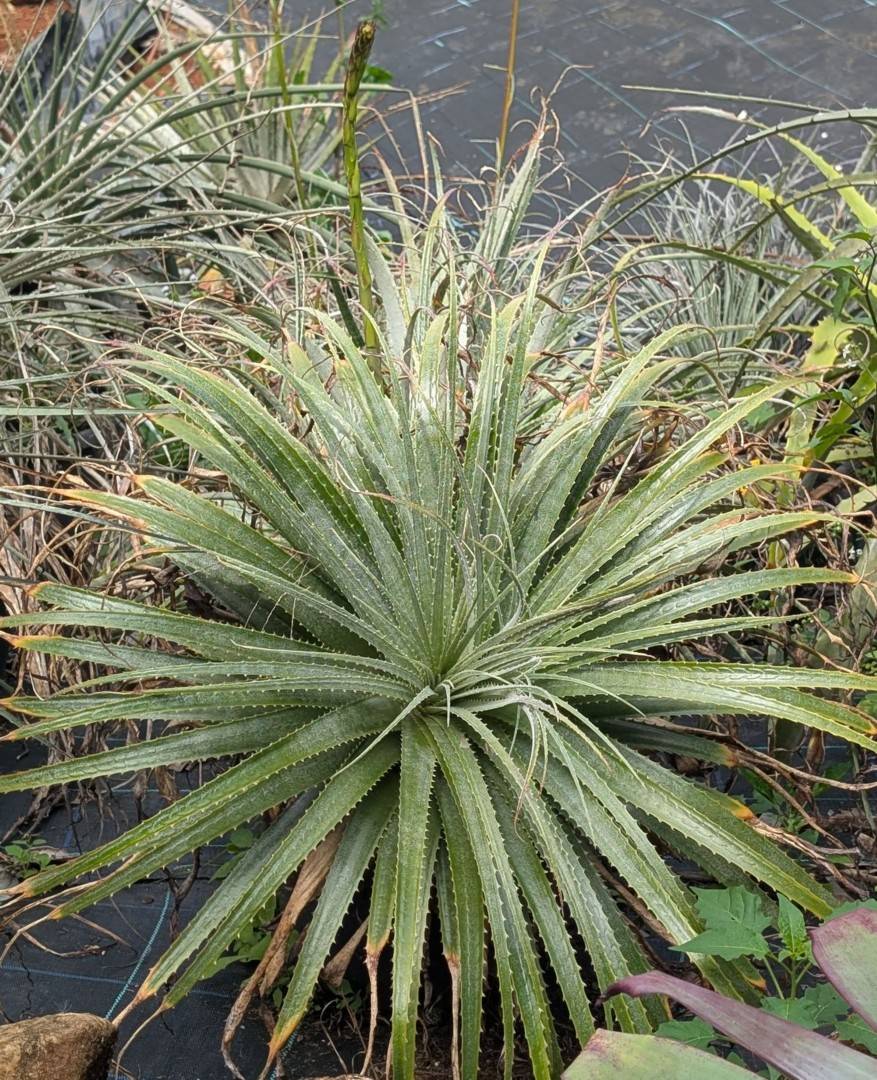
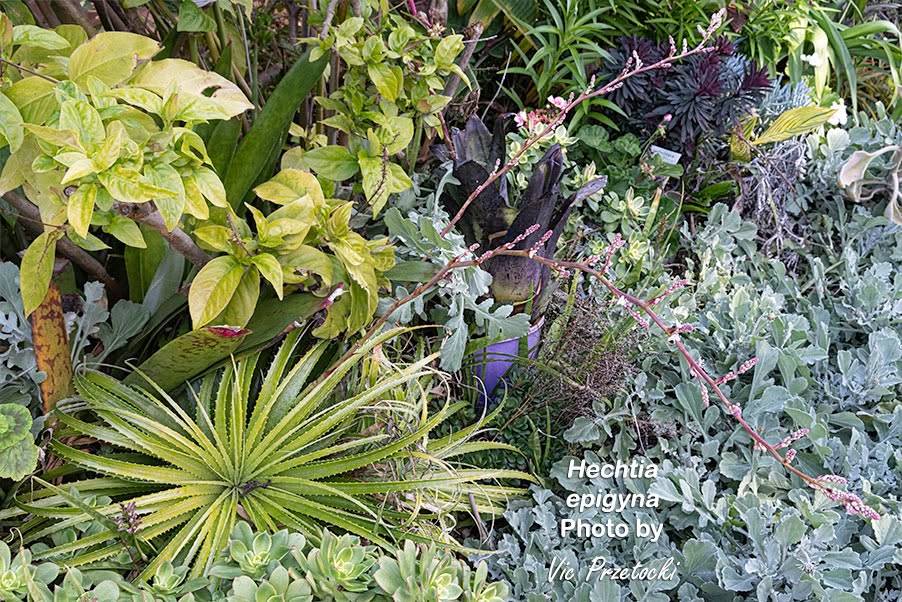
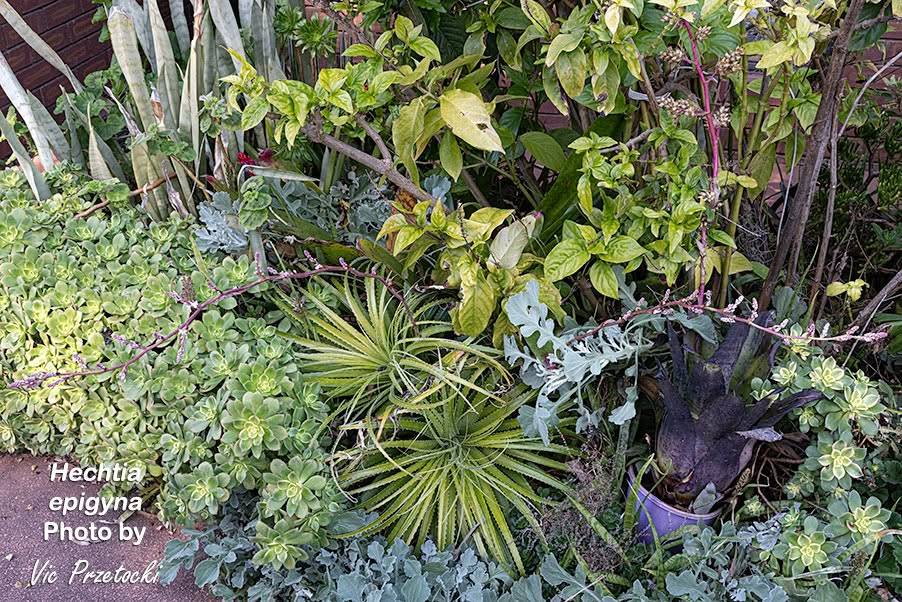
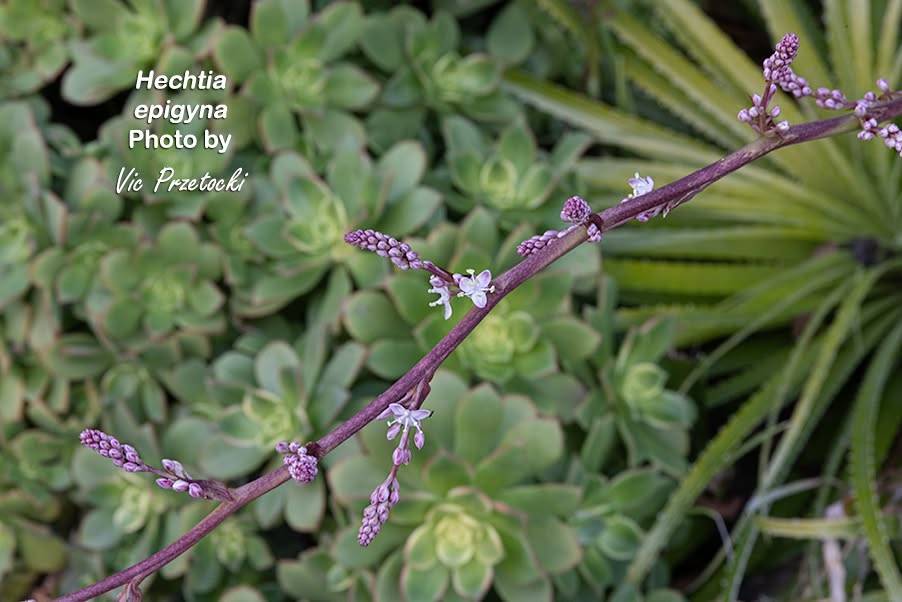
| Mitch Jones 08/26 just spiking |
Vic Przetocki 08/26 Male plant |
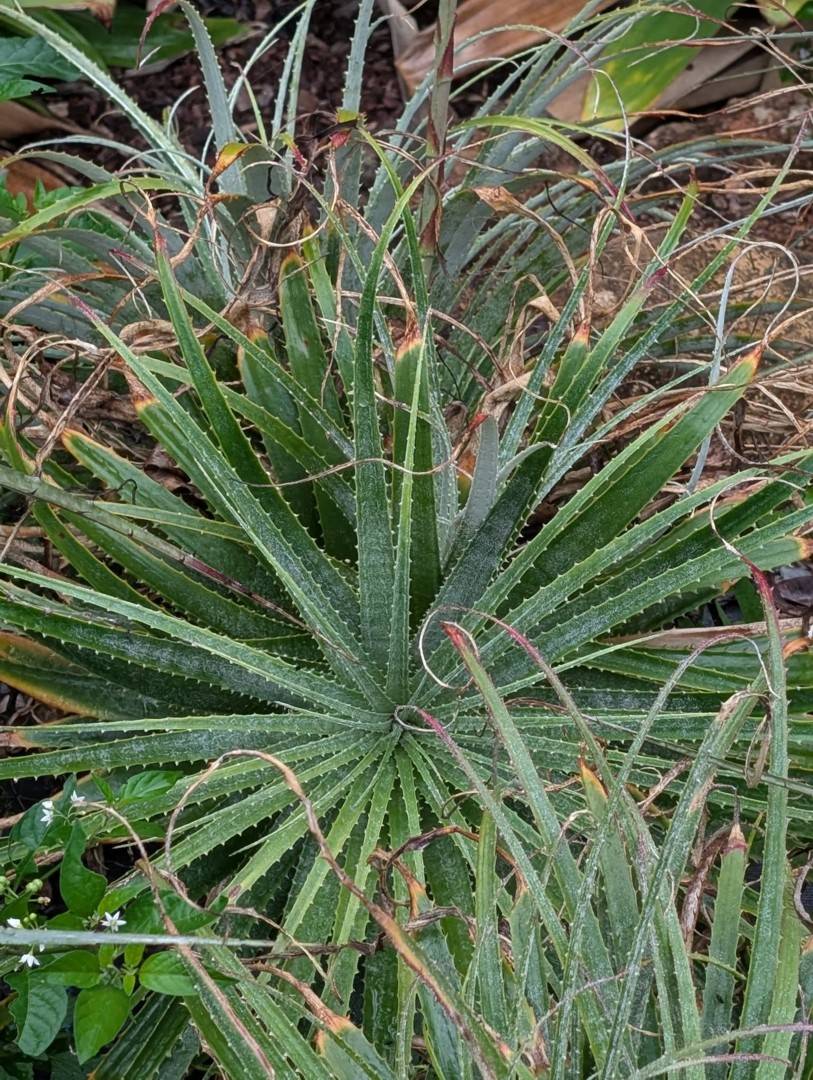
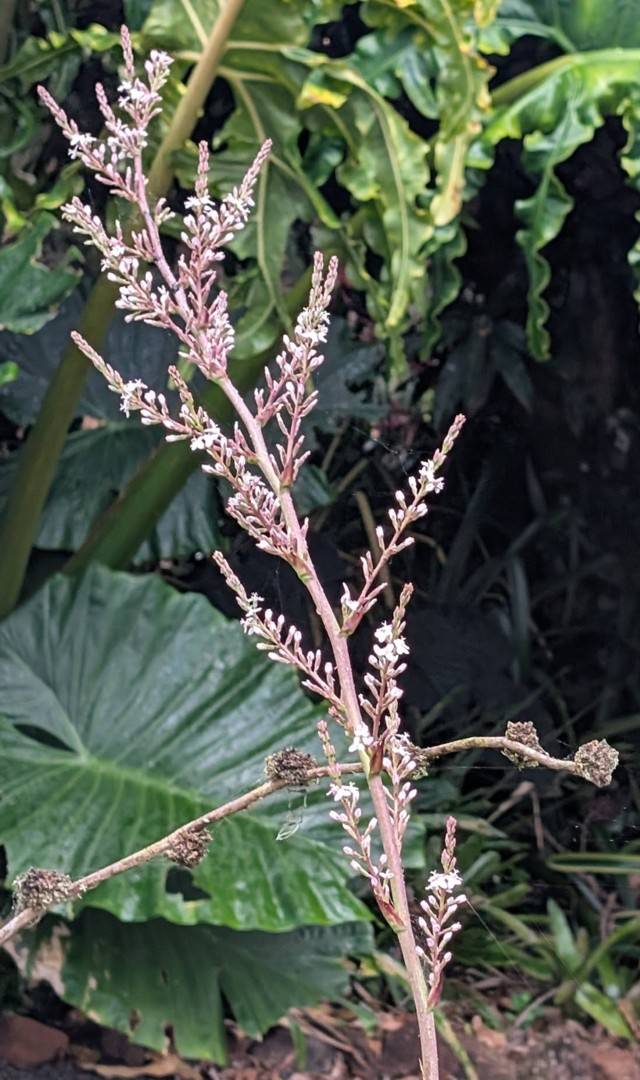
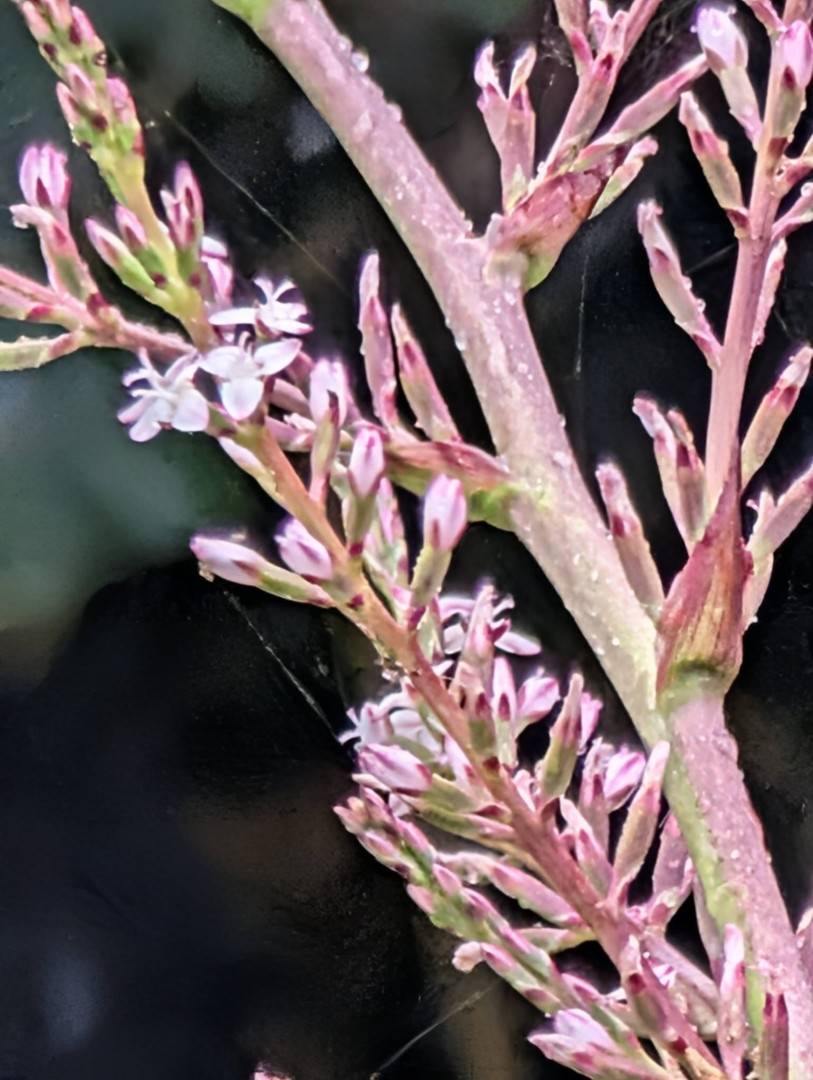
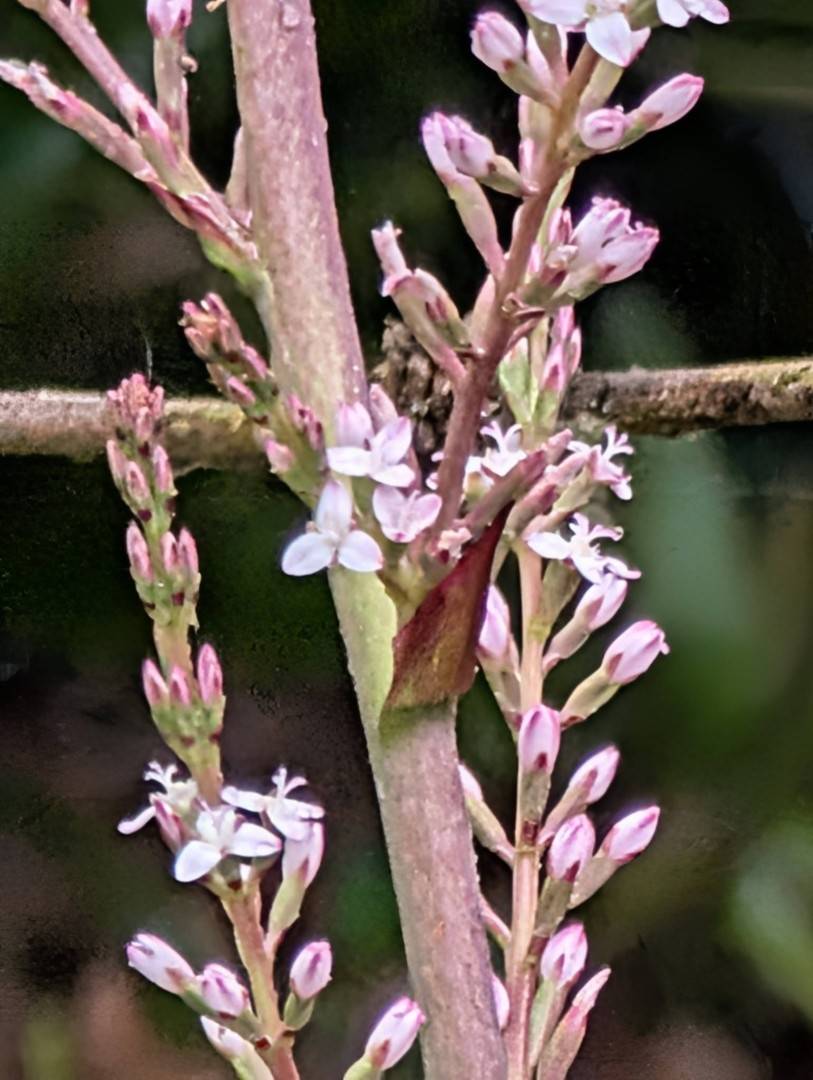
| Mitch Jones 09/26 Female plant |
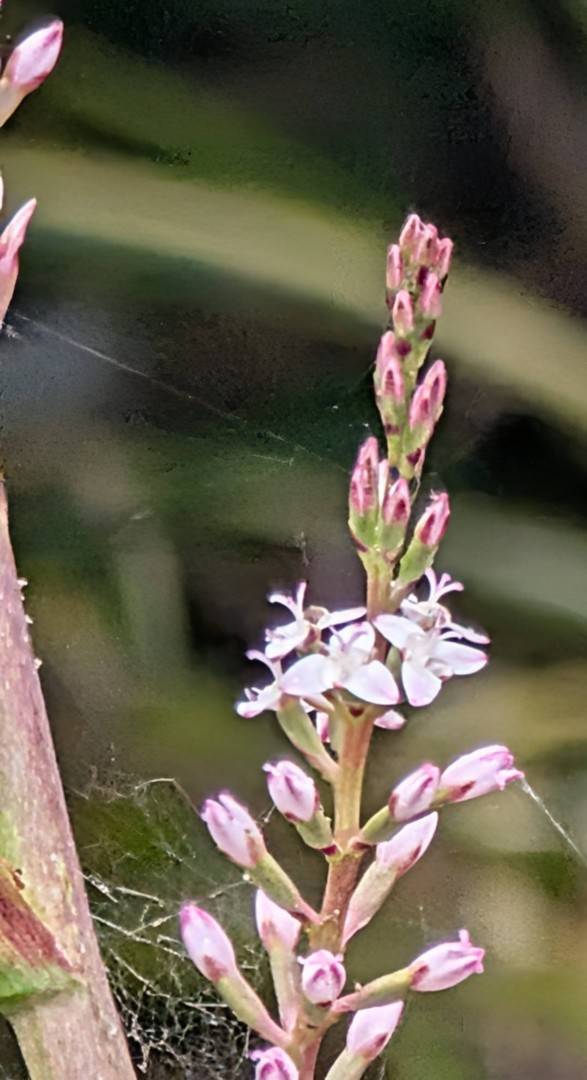
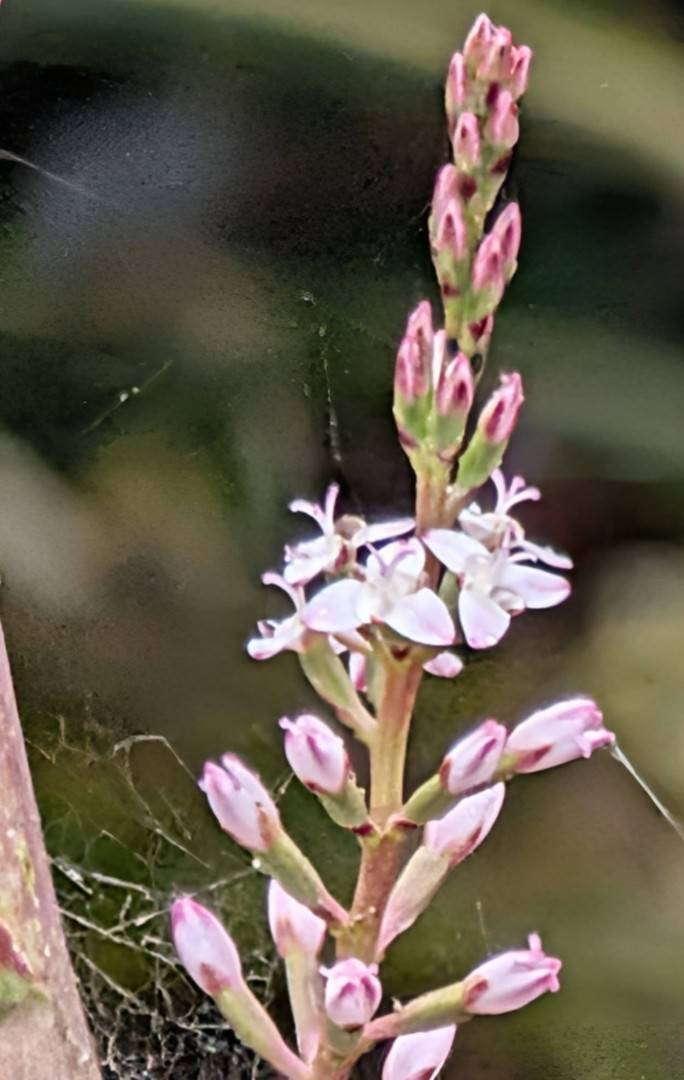
| Mitch Jones 09/26 Female plant |
Hechtia epigyna Harms, Notizbl. Bot. Gart. Berlin 12: 531. 1935.(Figs. 1 & 2) Detail from Espejo et al in Acta Bot. Mex. 90: 11-18. 2010
Translated by Butcher
Plant rupicolous, rosette, saxifrage, herbaceous, flowering up to 4 m high, the compact rosettes, up to 40 cm high and 30 cm in diameter;
leaves numerous, somewhat fleshy,
sheaths clear brown, broadly ovate to almost square, 4 to 6 cm long, 4.4 to 5 cm wide, thick white-lepidote on both surfaces, glabrescent when mature,
blades color dark green, narrow triangular, 28 to 40 cm long, 1.2-3 cm wide, the face densely white-lepidote towards base, glabrescent and shiny in the remaining part, the underside densely white-lepidote, long attenuate and slightly pungent at the apex, thorny in the margins, spines purple, triangular, curved towards the tip of the leaf, 1 to 2 mm long, 4 to 10 mm apart, with white scales in the axilla.
Inflorescences terminal, erect, racemose to paniculate,
- the male 1.8 to 2.5 m high, once divided, with up to 30 lateral branches,
Peduncle purple, pruinose, cylindrical, 1-1.2 m long, up to 16 mm in diameter at the base; peduncle bracts green tinged purple, foliaceous, narrow-triangular, 19 to 25 cm long, 6 to 12 mm wide, spiny on the margins, densely white-lepidote on the underside, glabrescent on the face, long attenuate and somewhat pungent at the apex, longer than the internodes;
primary bracts green tinged purple, sparsely white-lepidote, ovate, 2.6 to 5.5 cm long, 7-10 mm wide, spiny dentate on the margin and attenuate at the apex;
branches divaricate to ascending, one per node, cylindrical, 4-17 cm long, 1.5 to 2 cm diameter, the lower ones long pedicellate 2.7 to 3 cm long, and with two basal branches, the pedicles flattened, the upper ones short pedicellate, subsessile and without branches, the pedicles flattened and less than 1 cm long;
Floral bracts membranaceous, green, brown apically, ovate-elliptical, 6-7 mm long, 2.6 to 2.9 mm wide, sometimes erose with hyaline margin, acute at apex;
Flowers polystichous, divaricate, many per branch, actinomorphic, pedicellate, the pedicels somewhat ribbed, 4-5 mm long;
Sepals green, apically brown, triangular, 3.5 to 3.8 mm long, 1.8-2 mm wide, entire, acute at apex, glabrous;
Petals green, widely elliptical, 4.2 to 4.5 mm long, 3.3 to 3.5 mm wide, entire and rounded at the apex, extended in its apical half;
stamens 6, filaments white, flattened, triangular, 1.9 to 3.2 mm long, green, oblong, anthers ca. 1 mm long;
pistilode very small, green;
- the female 1.7 to 4 m high, once divided, with up to 16 side branches, the peduncle purple, pruinose, cylindrical, 1.2 to 2 m long, up to 20 mm in diameter at the base;
peduncle bracts green tinged purple, foliaceous, narrow-triangular, 19 to 25 cm long, 6 to 12 mm wide, spiny on the margins, densely white-lepidote on the underside, glabrescent on the face, long attenuate and slightly pungent at the apex, longer than the internodes;
primary bracts green tinged purple, sparsely white-lepidote, ovate, 2.6 to 5.5 cm long, 7-10 mm wide, spiny-dentate in the margin and attenuate at the apex;
branches divaricate to ascending, one per node, cylindrical, 6-14 cm long, 2.5 to 3 cm diameter, pedicellate, flattened pedicles, up to 1.5 cm long;
floral bracts, membranaceous, green, ovate-elliptical, to 8 mm long, 4-5 mm wide, rather erose, hyaline on the margin, acute at apex;
flowers polystichous, divaricate, many per branch, actinomorphic, pedicellate, pedicels ribbed, ca. 2 mm long;
sepals green, triangular, 4.5 to 4.9 mm long, 2 to 2.4 mm wide, entire, acute at apex, glabrous;
petals green, elliptical, 4.8 to 5.2 mm long, 2.8 to 3 mm wide, entire and rounded at the apex;
staminodes 6, white, laminar, triangular, 1.7 to 1.9 mm long, without anthers;
ovary inferior, green, ellipsoid, 5-7 mm long, 2.5 to 2.8 mm diameter, acrescent,
stigmas three, sessile, greenish white, linear, recurved, ca. 3.5 mm long.
Capsule green tinged red towards the tip, brown to dark brown when mature, ellipsoid to long ellipsoid, sometimes trigonous and sometimes ribbed, 10-14 mm long, 4 to 4.5 mm diameter;
Seed brown to reddish brown, fusiform, reticulate, ca. 3 mm long, ca. 1 mm wide, with a narrow side wing which ends in two tails, one winged and a hyaline tail.
Examples examined: HIDALGO: Puente de Dios, Municipio de Acyopan, 20deg18'13"N, 98deg47'20" W, laderas de rocas calizas con vegetacion de bosque de Juniperus en transicion con el matorral submontano, 1740 m, 25-VIII-2007, S. Zamudio, R. Alcala y colaboradores 13866 (IEB); alrededores de Puente de Dios, Municipio de Actoban, 20deg18'08" N, 98deg47'23" W, matorral con Juniperus, Dasylirion y Brahea sobre sustrato calizo, 1735 m, 15-V-2008 (planta masculina), A. R. Lopez-Ferrari, A. Espejo y S. Zamudio 3309 (IEB,UAMIZ); (planta femenina) 3311 (IEB, UAMIZ), Barranca de Tolantongo, Municipio de Cardonal, 20deg37'52" N, 98deg59'30"W, matorral rosetofilo con Agave, Tillandsia albida y T. grandis, 1739 m, 16-V-2008, (planta femenina) A. Espejo, A. R. Lopez-Ferrari y S. Zamudio 7150 (IEB,UAMIZ),
(planta masculina) 7151 (IEB,UAMIZ); bajada a la Barranca de Tolantongo por el ejido San Cristobal, Municipio de Cardonal, 20deg38'20" N, 98deg59'30" W, riscos de rocas calizas con Hechtia spp., Tillandsia spp. y Agave spp., 1800 m, 18-III-2008 (planta femenina), S. Zamudio y E. Zamudio 14085 (IEB,UAMIZ). TAMAULIPAS: Jaumave, Municipio de Jaumave, 2-III-1930, H. W. Viereck 81 (Tipo: B(x2)) (plantas femeninas y masculinas), near Nogales, Jaumave, Municipio de Jaumave, II-1933, H. W. von Rozynski 741 (GH) (plantas masculinas).
Distribution and habitat. Hechtia epigyna is recorded so far in the Amajac River basin, in the municipalities of Actopan and Cardonal in the State of Hidalgo, as well as the vicinity of the town of Jaumave in the municipality of the same name in Tamaulipas (Fig. 3). Populations encountered by us in Hidalgo are small to medium-sized colonies and grow between 1700 and 1800 m a.s.l. scattered on cliffs and almost vertical limestone slopes, associated with other calciocole species such as Hechtia glomerata Zucc. and Agave striata Zucc., and are abundant and prospering (Fig. 2 a and b). Flowering and fruiting from May to July.
State of conservation. Known populations of Hechtia epigyna are abundant and widely dispersed and usually grow in inaccessible vertical cliffs and slopes. Apparently, the plants are not used by the inhabitants of the region, so we think that the species does not suffer from anthropic pressure. However, and due to the lack of detailed information about populations and the precise distribution of the species, we suggest its inclusion in the category Data Deficient (DD) on the IUCN (Anon, 2003).
Notes
Of the 19 genera of Bromeliaceae present in Mexico, Hechtia is particularly interesting due to the strong representation of its components and its high level of endemism (Burt Utley and Utley, 1987;) Espejo-Serna et al., 2004). It is also one of the more difficult groups from the taxonomic standpoint and delimitation and correct identification of species is a problem for scholars of the family. This situation is due, at least in part, to lack of exsiccata sufficient and representative, or to that which are incomplete or fragmentary. Plants of the genus, with the exception of H. gayorum L. W. Lenz (Lenz, 1995), are dioecious and are frequently found in flowering individuals of only one of the sexes. This is analytically complicated in their collection since they are generally hardy plants with strongly spiny leaves, hindering the preparation of herbarium specimens.
Many of the species of the genus have a restricted distribution (Espejo-Serna et a1., 2004). In several cases this situation is a reflection of the specificity of the substrate on which plants grow, since some thrive only on volcanic rocks (eg. Hechtia pretiosa Espejo & Lopez Ferrari, H. matudae L. B. Sm., H. stenopetala Klotzsch) and others prefer limestone (Hechtia zamudioi Espejo, López-Ferrari & I. Ramírez, H. caulescens Martinez-Correa, Espejo & López-Ferrari, H. schottii Baker ex Hemsl., or over chalky terrain (Hechtia aff. capituligera Mez). However, this situation also may be at the failing of botanical exploration or lack of adequate and complete specimens that can be correctly identified, as is the case that we will show here.
From the year in which it was described (Harms, 1935) until now, Hechtia epigyna Harms, was known only from two collections (Viereck 81 (type: B (x 2)!, fig. l) and Rozynski 741 (GH!)) (Smith, 1938;) Smith and Downs, 1974), both from the type locality in the vicinity of Jaumave, Tamaulipas. We recently discovered in the State of Hidalgo Hechtia material, which is without a doubt referred to that species. The plants were found on limestone slopes with Juniperus forest in transition with submontane shrub and thickets of rosette like plants. The discovery of these populations in a far distant site to the south of the original town allows us to guess that the taxon could be recorded eventually in other States of intermediate location, San Luis Potosi or Queretaro.
It should be noted here that Smith mentioned in Flora of North America (1938) Hechtia epigyna staminate flowers had white petals, while Smith and Downs in Flora Neotropica (1974) indicated in the description of this species that both flowers, pistillate and staminate petals, were pink. In reality as seen in Figure 2 c, d, f and g, the flowers of both sexes are green at anthesis and dry to white or creamy-white.
Hechtia epigyna is the only Mexican species of the genus with inferior ovary, which is also present in H. dichroantha Donn. Sm., H. malvernii Mez and H. guatemalensis Gilmartin, known in Central America.
Although the protologue for H. epigyna includes information of plants of both sexes, this is incomplete due to the type material (Fig. 1) being fragmented, so we include here an updated description and details of the male and female plants, based on material both alive and in the herbarium.
Hechtia epigyna Harms, Notizbl. Bot. Gart. Berlin 12: 531. 1935.
Plant known only from fragments, probably 1 m high or more.
Leaves 35-40 cm long;
blades linear-triangular, subfiliform-attenuate, 2-3 cm wide at base, densely white scurfy on both sides, becoming glabrous with age, densely serrulate toward the apex, the teeth stout, uncinate, pale, up to 3 mm long and 12 mm apart, coarsely lepidote in the axils.
Scape unknown.
Inflorescence laxly bipinnate or possibly tripinnate (! Harms), subcylindric, glabrous; axes slender;
bracts subtending the racemes broadly ovate, apiculate, 7-15 mm long, thin;
racemes suberect or ascending, short-stipitate, dense or lax, 3-7 cm long.
Floral bracts broadly elliptic, acute, 3-4 mm long, membranaceous, white;
flowers spreading or ascending; pedicels slender, terete, slightly enlarged toward apex, the staminate 6-7 mm long, the pistillate about 3 mm long.
Sepals subovate, obtuse, 2.5-3.5 mm long, pale-brown, membranaceous;
petals broadly elliptic, obtuse, cucullate, 5 mm long, rose;
stamens equaling the petals; filaments free;
ovary (or its minute rudiment) almost wholly inferior, trigonous, 5-10 mm long; ovules numerous, fusiform, biacuminate.
TYPE. Viereck 81 (holotype, B), Jaumave, Tamaulipas, Mexico.
DISTRIBUTION. Known from the type locality only.
MEXICO. TAMAULIPAS: Jaumave, Feb 1933, Rozynski 741 (F, GH). WITHOUT LOCALITY: Cultivated, May 1961, MarnierLapostolle s n (US).
Updated 03/10/26