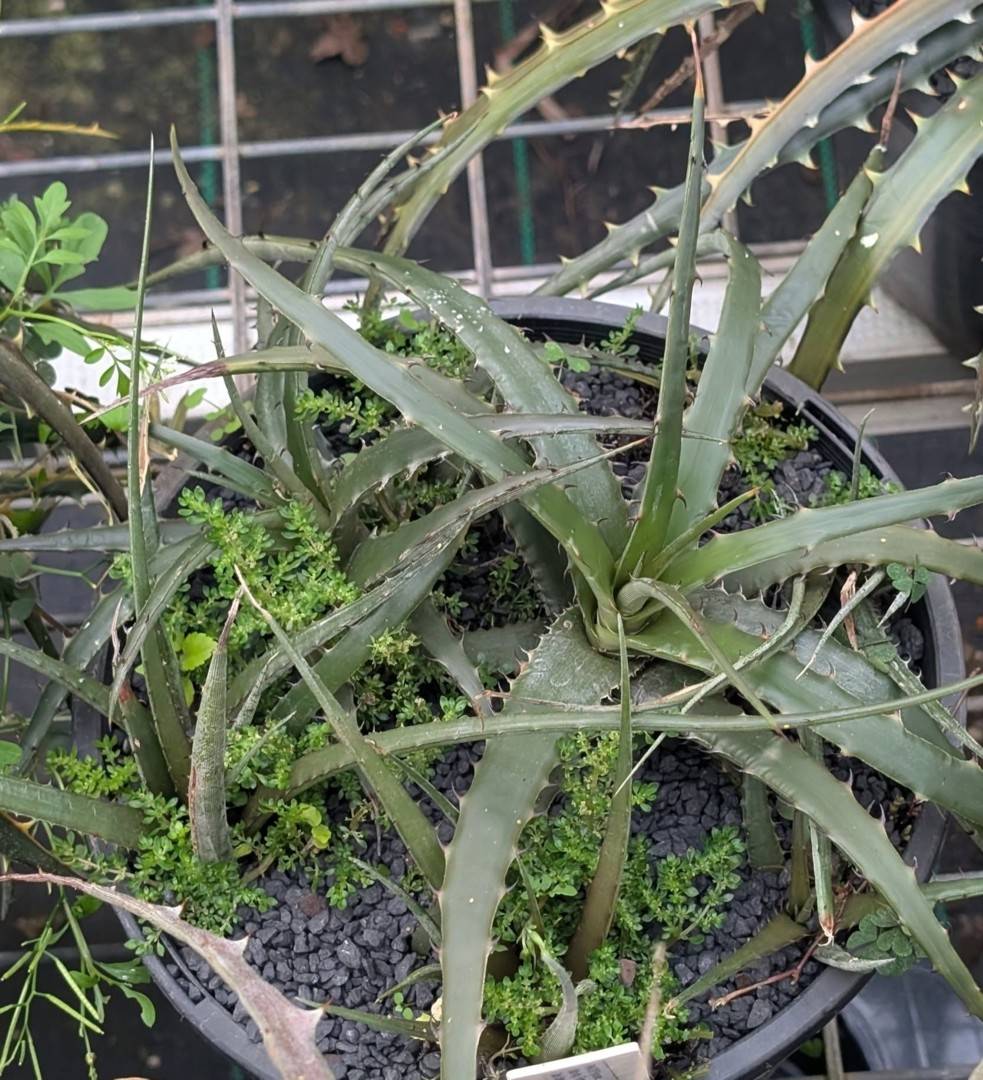
Castellanos notes that the Matacos Indians of Formosa, Argentina, use this species for cordage.
DEINACANTHON URBANIANUM and the Uses Given to it by the Mataco Indians by Alberto Castellanos in Brom.Soc. Bull. 4(5): 79-81. 1954
In this species of terrestrial Bromeliaceae, the plants emit rhizomes with much ramified roots and emerge from the ground as a rosette of 10-18 ensiform phyllodes, 10-40 cm long and 1-1.5 cm broad; grooved, succulent, grayish and lepidote; the edges are provided with terrible black spines of about 4 mm in length, distant 5 mm from each other at the base and twice as much in the upper portion; the phyllode's point ends in a straight black spine. As often occurs in the phyllodes of many spiny Bromeliaceae, the upper half of the marginal spines are pointed in one direction and the lower half in the opposite one, a fact which prevents the hand from reaching the bottom of the foliar rosette.
The flowers send forth a nauseous smell; they are externally tomentose, 3-3.5 cm long, sessile and in groups of 3 to 5 in the center of the foliar rosette; they are placed in the axilla of a deltoid bract, as long or longer than the flowers. The external sepals are deltoid (about 18 mm long and 7 mm wide) free, with their back side acute but not ridged; the inner ones are whitish instead, they carry two appendicular submarginal ligulae in the lower portion and are joined at their base. The androecium is somewhat longer than the perianth, the staminal filaments are thick and the anthers pink, sub-basifixed, curved outwardly and about 7 mm long. The filaments are joined in their lower portion forming a tepal-staminal tube. The pollen grains are globular and, as seen directly under the microscope, they show a single pore. The pistil has an inferior and felted ovary, in the shape of an inverted pyramid, about 18 mm long and 5-6 mm in diameter, with a central multiovulate placenta and a thick, columnar style, shorter than the perianth, and three spiral, papillate stigmatic branches 4 mm long.
The fruits are dry berries, globular or elipsoidal, trigonous, crowned by the withered perianth, about 3.5 cm long and 2.5 cm broad, orange colored, lepidote at the base, white and fibrous within, with many cuneiform or semilunar seeds of a brownish or pearly color, piled like coins.
A monotypical South American genus, its only species was described as Rhodostachys urbanianurn Mez in Flora Brasiliensis (1891), 182, tab. 51, proceeding from the Argentine Republic, Province of Cordoba, Chacra de la Merced, a place near Cordoba city, capital of the province.
Later this species was separated as the genus Deinacanthon in the Monograph of Bromeliaceae published by Mez in 1896.
There exist accurate illustrations of the species in Martins, Fl. Bras. III (1891) tab. 51 sub Rhodostachys urbaniana Mez; Pflanzenreich (1934) fig. 10. Castellanos, Generos Bromeliaceas (1938) fig. 1 and tab. 2; in Descole, Genera Plantarum III (1945) tab. 28, and Bagonese, Salinas Grandes (1951) fig. 7.
In Argentina the plant is popularly called chaguar or chahuar, and the fruit chalude.
Its geographical area, quite extensive and unique, covers the following South American territories: Paraguay (Puerto Casado) and Argentina (Formosa, Chaco, Salta, Santa Fe, Santiago del Estero, La Rioja, Cordoba, San Luis, Mendoza). It is thus a characteristic species of the Chaquenian and central botanical provinces, which extend over Argentina, Paraguay and the south of Bolivia.
This peculiar plant forms tufts on the clay-soil plains by means of its rhizomes; it is only rarely found in the stony ground of the lower "curras de nivel" corresponding to the hills which exist within its geographical area. It often happens that they grow under small and open-branched bushes, whose leaves impart little shade; this favors the growth of Deinacanthon which is an heliophilous and xerophilous plant. When these patches appear in the open country they are impassable because of their terrible spines.
As do all other Argentine Bromeliaceae, it flowers early in the spring. Its whitish flower opens in the center of the foliar rosette and sends forth a cadaverous smell. It secretes abundant nectar, which often overflows over the perianthic leaves, and can only be sucked by the flies who are attracted by the flower's unpleasant odor.
The plant stores water in the aquiferous parenchyma of its phyllodes which occupies the upper portion of the limb and when abundant makes them rigid and reaches half a centimeter in thickness, being easily seen with the naked eye in a transverse section. On the contrary, when it is exhausted the phyllodes are reduced to their fibers and they curl somewhat, looking like wires.
The fruit takes a long time to ripen, from spring to the end of summer, consuming the greater part of the water stored in the aquiferous parenchyma. Then the recurving phyllodes open the rosette, an opportunity of which the wild hogs take advantage. Foxes, in spite of their carnivorous diet, eat them occasionally, using their front paws to detach them from the plant, if they are still upon it when they have reached maturity.
In the Chaquenian territories I have seen the Mataco Indians employ the fibers of Deinacanthon's phyllodes in the making of nets which they use for carrying the results of hunting or fishing. (See photo of Balsa)
They achieve the manufacture of these nets in the following manner. Very carefully, in order to avoid the terrible spines, they take the peripheral phyllodes of the rosette between the forefinger and thumb and separate them with a sharp pull; afterwards, by means of their iron-like nails and great ability, they rid them of the marginal spines. Once disarmed, they twist them quickly and strongly, submitting them to a sudden mechanical retting until only a greenish bundle of fibers remains in their hands. They allow these to dry and then start weaving their nets which they sometimes dye with dark colors. For a long time the nets retain a characteristic nauseous smell which makes one think of the indolent Mataco Indians themselves.
These nets are very tough; they can resist weights of many kilograms as I have had the opportunity to test in the Santiaguenian Chaco. The only condition required is that they must always be dry, for, once wet, they easily break. This quality denotes a perfect adaptation to the long periods of drought which are characteristic of the plant's geographical area.