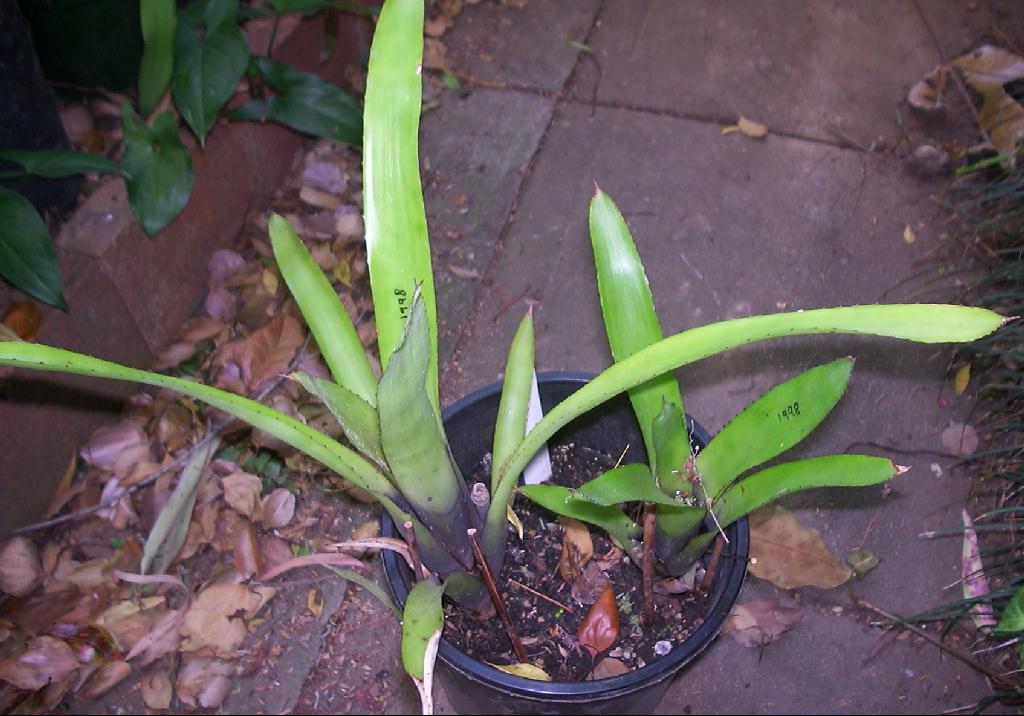
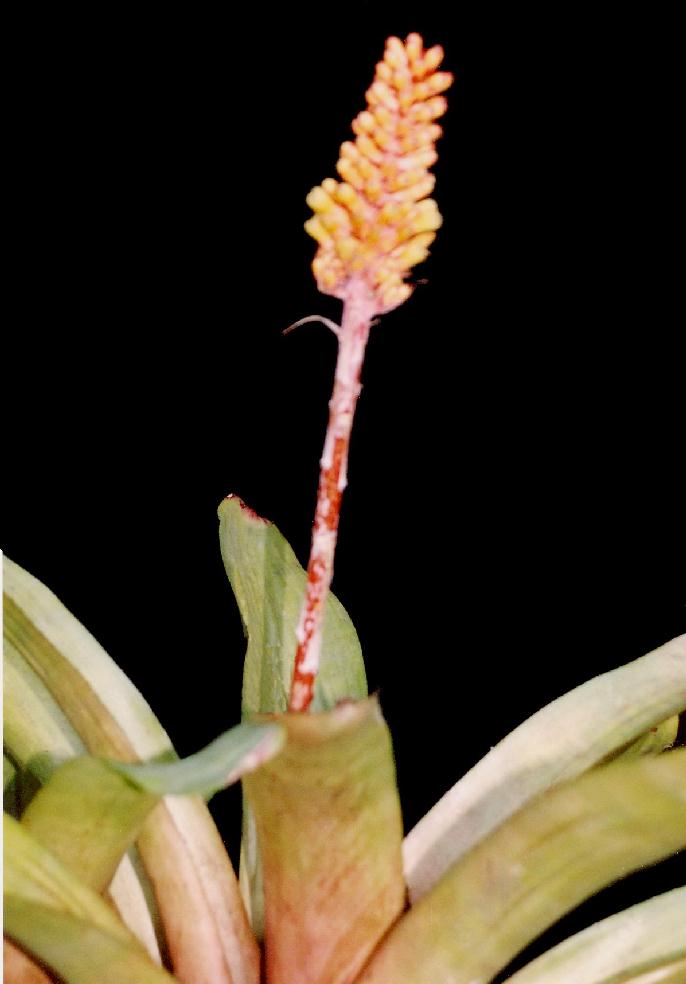
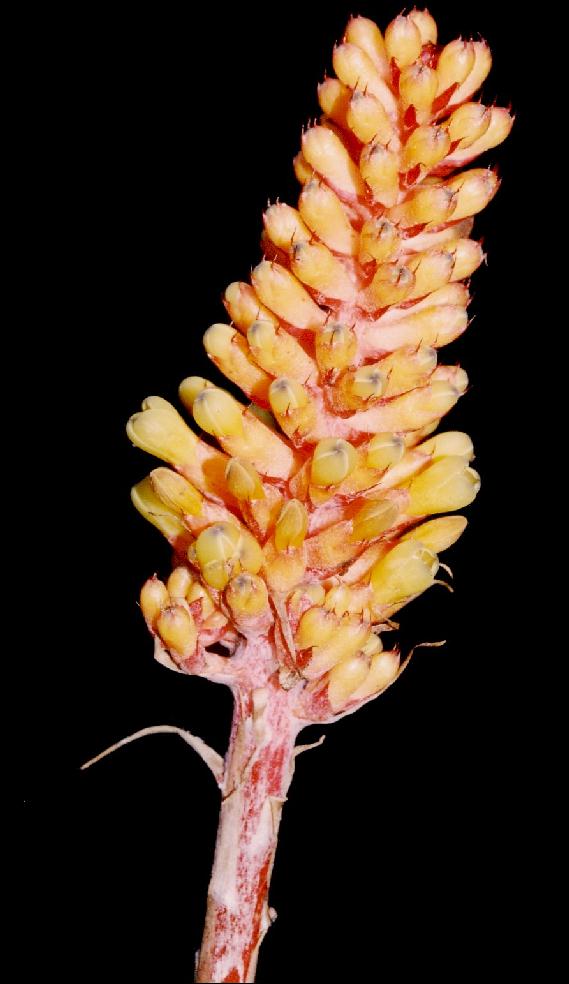


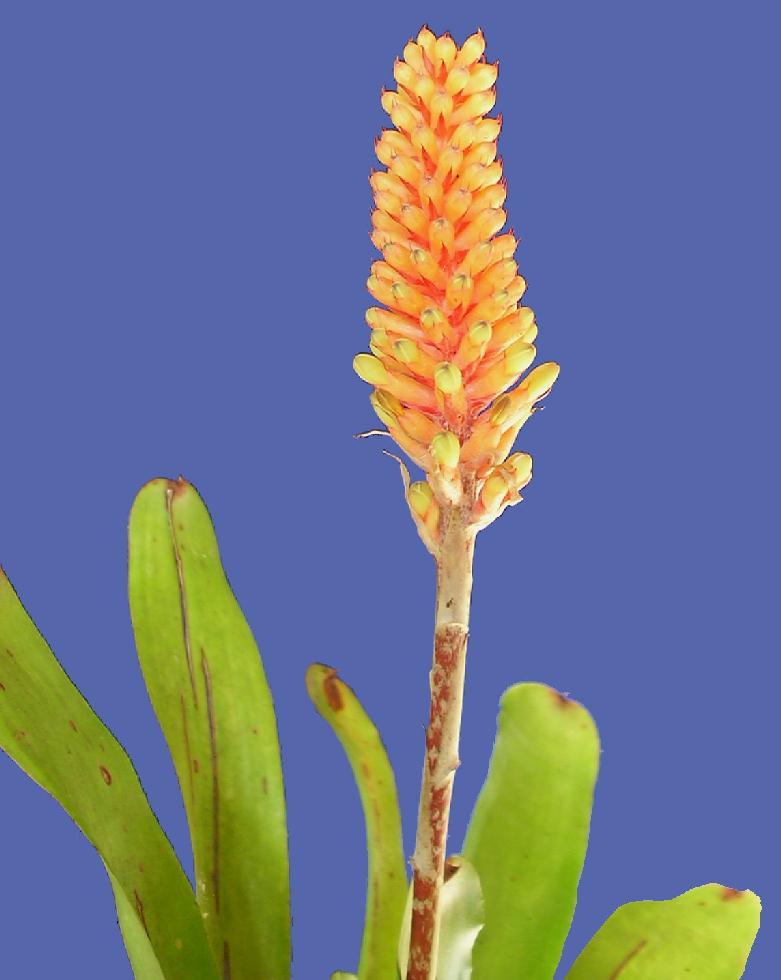
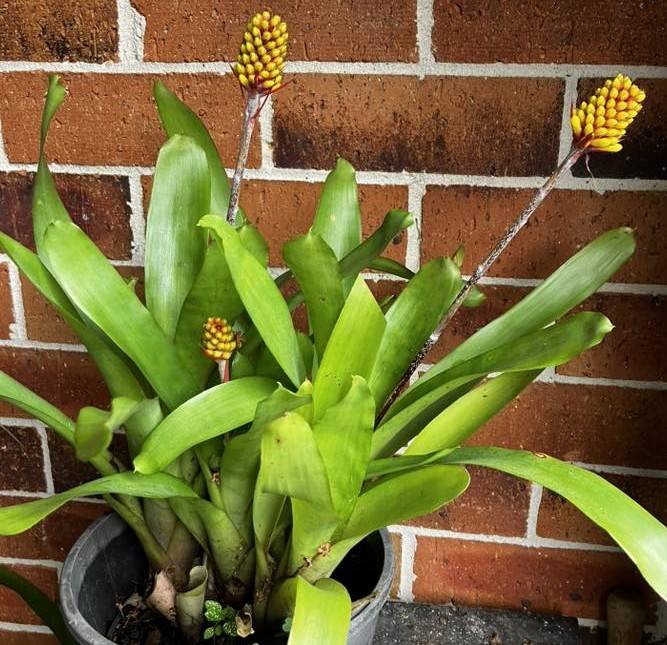
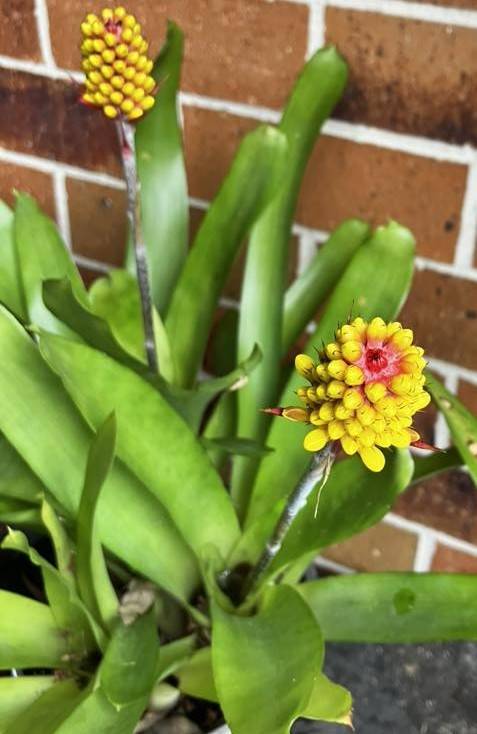
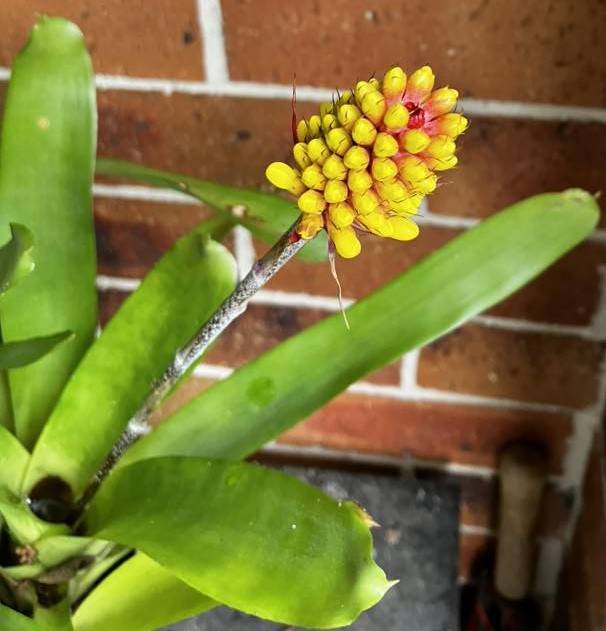
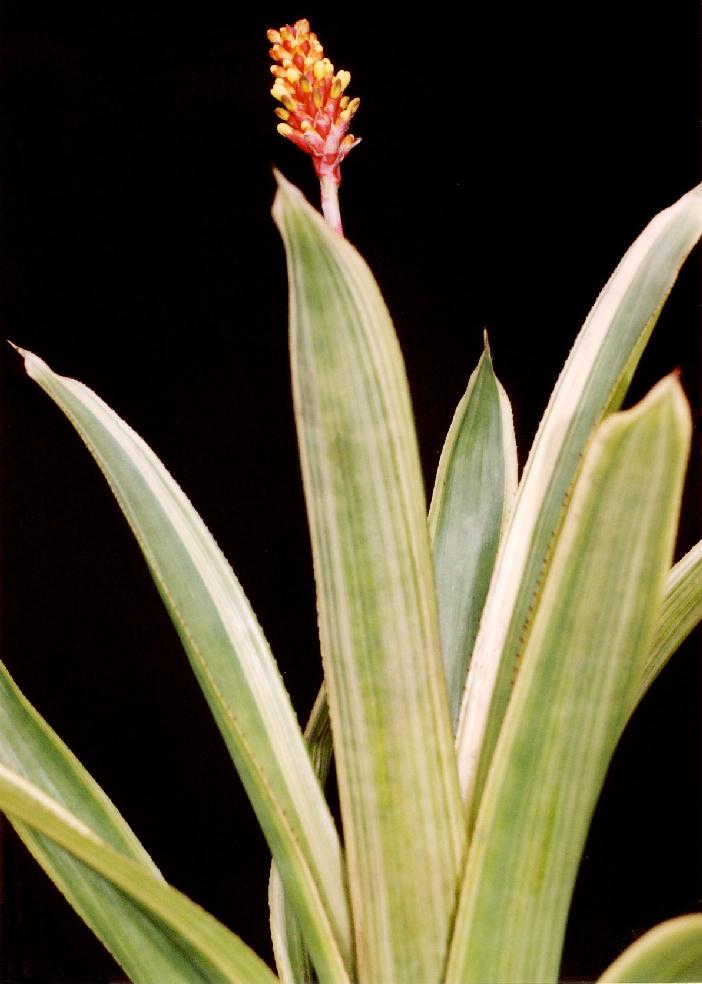

Aechmea comata var comata
Pothuava comata Gaudichaud, Atl. Voy. Bonite, pI. 116. 1852;
Hoplophytum lindenii E. Morren, Belg. Hortic. 15: 164. 1865. Type, Gaudichaud s n (P) Brazil. (LG, clonotype), May 1885, from Libon, from Santa Catarina, Brazil.
Aechmea lindenii (E. Morren) Baker, Jour. Bot. London 17: 233. 1879.
Macrochordium lindenii Wittmack, Bot. Jahrb. 13(Beibl. 29): 23. 1891.
Leaf-blades concolorous, wholly green.
Type. Linden Hortus ex Morren Hortus s n (LG, clonotype), May 1885, from Libon from Santa Catarina, Brazil.
Comments from Walter Till Sept 2005 Pothuava comata Gaudich., the epithet bringing name, is from 1852 (not 1851, see Taxonomic Literature, 2nd ed, 1: 923 (1976)) and its type is plate 116 of Gaudichaud, Voyage de la Bonite, Atlas. The type of Hoplophytum lindenii, the basionym of Aechmea lindenii, is Gaudichaud s. n., a plant cultivated in Morren's garden in Liege. The material cited in Fl. Neotrop. 14(3): 1880 (1979) is not the type but (probably) a descendant of Gaudichaud s. n. which was given to Linden and then returned to Liege and flowered 20 years later, hence a clonotype (NOT a nomenclatoric type in the application of the ICBN.) See also the entry under Hoplophytum lindenii in Fl. Neotrop. 14(3): 1880, (1979)
Distribution. On rocks and dunes and epiphytic in coastal forest, 5-50 m alt, Santa Catarina and adjacent Rio Grande do Sul, Brazil.
BRAZIL. Santa Catarina: Sao Jose, 23 Oct 1929, Hoehne s n (GH, SP); Ilha de Santa Catarina, Florianopolis, 2 Sep 1945, Rohr 457(GH, SP); 26 Jan 1951, Reitz 3831 (HBR); 3831a (HBR); 3933 (HBR, US); 12 Dec 1951, 4260 (HBR); 13 Mar 1952, L. B. Smith & Reitz 6204 (R, RB, US); 28 Ju1 1965, Klein & Bresolin 6098 (FLOR, HBR); 26 Ju1 1967, 7518 (FLOR, HBR); Fachinal, Biguacu, 17 Jan 1945, Reitz C-929 (HBR); Maciambu, Palhoca, Reitz & Klein 1046 (! Reitz); Canto Grande, Porto Belo, 25 Jul 1950, Reitz 3629 in part (HBR, US); Paulo Lopes, 29 Nov 1950, Reitz 3704 (HBR); 19 Sep 1951, Reitz & Klein 39 (HBR). Rio Grande do Sul: Torres, 21 May 1893, Golland in Lindman s n (S).
Aechmea comata var makoyana (Mez) L. B. Smith, Smithson. Misc. Collect. 126: 14, 221. 1955;
Aechmea makoyana Hort. Makoy ex Rev. Hortic. 65: 203.1893, nomen.
Hoplophytum lineatum hortus ex Gard. Chron. for 1893(1): 414. 1893. Type. Bull Hortus 4223 (K ? n v)
? Lamprococcus speciosus hort. Bull ex. Gard. Chron. for 1893(1 ): 414. 1893. Type. Bull Hortus 4222 (? n v).
Aechmea lindenii forma "Hoplophytum makoyanum" hortus ex Mez, DC. Monogr. Phan. 9: 265. 1896.
? Billbergia forgetiana Sander Hortus in Gard. Chron. 258, fig. 102 on p. 266. 1903.
Aechmea lindenii var makoyana Mez, Pflanzenreich IV. 32: 159. 1934.
Leaf -blades yellow-striped.
Type. Described from cultivation. n v. Distribution. Unknown.
Detail from Reitz Bromeliaceas 1983
Material estudado - SANTA CATARINA: FLORIANOPOLIS: Praia dos Ingleses, IIha de Santa Catarlna, A. Seldel s. nr. (15.05.1965), HBR,; Horto Botanico da Universidade Federal de Santa Catarina, Trindade, flor, A. Bresolin 1238 (14.10.1976), HBR, planta, encontrada no Morro dos Ingleses e cultlvada no Horto Botanico onde floresceu; o clone continua sendo cultlvado no Horto Florestal e na casa de Raulino Reitz, em Itapema, que ja distribuiu diversas mudas para bromelicultores; foi desenhada para esta obra por D. Fossari; ibidem, A. Bresolin 1278 (31.05.1977), FLOR; ibidem, A. Bresolin 1289, FLOR, HBR.
Area de dispersao - SANTA CATARINA: Ate agora somente encontrada na Ilha de S. Catarina, municipio de Florianopolis.
AECHMEA LINDENI by Baker in Curtis Mag. 107: t. 6565. 1881
TAB: 6565
Native of South Brazil.
Nat. Ord. BROMELIACEAE --- Tribe BILLBERGIEAE.
Genus AECHMEA, Ruiz et Pavon; (Baker in Trimen Journ. Bot. N. S. Vol. viii. p.129)
AECHMEA (Pothuava) Lindeni. ; acaulis, caespitosa, foliis circiter 20 loratis rigidis erectis 2-3-pedalibus apice rotundatis minute cuspidatis facie viridibus canaliculatis dorso obscure lepidotis et lineatis margine aculeis minutis deltoideis ascendentibus armatis, pedunculo subpedali foliis pluribus parvis lanceolatis scariosis adpressis superioribus rubellis praedito, floribus multis in spicam densam oblongam simplicem aggregatis, bracteis membranaceis rubris inferioribus lanceolatis acutis calyce aequilongis, ovario oblongo luteo glabro, sepalis deltoideo-orbicularibus imbricatis distincte oblique cuspidatis, petalis lingulatis citrinis sepalis duplo longioribus basi appendicutatis, genitalibus inclusis.
Ae. (Pothuava) Lindeni, Baker in Trimen Journ. N. S. vol. viii. (1879) p. 233.
HOPLOPHYTUM Lindeni, E. Morren in Belg. Hort. Vol. xv. (1865) p. 164; vol. xxiii. (1873) p. 81, t. 5 ; K. Koch in Wochenschrift, vol. viii. (1865) p. 398.
Next to Billbergia, Aechmea may fairly be considered the most effective genus of Bromeliads for decorative purposes. Of late years our knowledge of it has rapidly increased, and several fine new species have been brought into cultivation. Taking the genus in a broad sense, so as to include Hoplophytum, Echinostachys, Pothuava, and Canistrum, as it is treated in my monograph in the Journal of Botany above cited, we know now not less than sixty species, so that next to Tillandsia it is the largest genus in the Natural Order. The present plant was distributed by Linden in 1865, and was received by him from M. Libon, who discovered it in the province of Santa Catherina, in South Brazil. Our drawing was made from a plant presented to the Kew collection by Mr. J. T. Peacock, which flowered in the palm-stove in March, 1879. It is a near ally of the plant figured by Gaudichaud (Atlas Bonite, Tab. 117) under the name of Pothuava spicata, which I take to be merely a variety of the widely-diffused Aechmea nudicaulis of Grisebach, the Bromelia nudicaulis of Linnaeus.
DESCR. Tufts sessile. crowded.
Leaves about twenty in a rosette, lorate, rigid in texture, erect, two or three feet long, three inches broad at the dilated base, one and a half or two inches at the middle, rounded with a small cusp at the apex, green and glabrous on the channelled face, obscurely lepidote and lineate on the back, the edge bordered by minute ascending horny teeth.
Peduncle about a foot long, with several small ascending lanceolate, adpressed scariose leaves, the upper tinted red.
Flowers numerous, tightly packed in a dense simple oblong spike two or three inches long;
bracts one to each flower, bright red, membranous in texture, the lower ones lanceolate acute, as long as the calyx, the upper ones shorter and obtuse, with a cusp.
Calyx not more than half an inch long including the ovary, which is oblong, glabrous, and bright orange-yellow;
sepals orbicular-deltoid, horny, imbricated, with a large oblique cusp.
Petals lingulate, obtuse, lemon-yellow, twice as long as the sepals, scaled inside at the base.
Stamens included;
filaments and anthers both linear, lemon-yellow, the latter dorsifixed and erect.
Ovary many in a cell, central, horizontal;
style filiform;
stigmas linear, spirally twisted.
---J. G. Baker.